 how-to
Avoiding Common Residential Driveway Construction Mistakes
Table of Contents
- Why Most Residential Driveway Construction Mistakes Start Before the First Pour
- Driveway Base Preparation Mistakes That Cause Early Failure
- Driveway Drainage Problems: The Mistakes That Flood Your Investment
- Driveway Contractor Questions You Must Ask Before Signing
- New Driveway Curing Time Mistakes That Weaken the Slab
- Thickness, Joints, and Reinforcement: Mistakes That Lead to Cracks
- How Delpres Services Helps Chesterfield Homeowners Avoid These Driveway Construction Mistakes
- Conclusion
- Frequently Asked Questions
Last Updated: October 6, 2026
Why Most Residential Driveway Construction Mistakes Start Before the First Pour
Most driveway failures begin long before concrete or asphalt shows up. They start with skipped planning, bad grading, and rushed site prep. Avoiding common residential driveway construction mistakes is really about what happens in the first few days of a project, not the last.
At Delpres Services, we've spent 20+ years building and replacing driveways across Metro Detroit. The pattern is always the same. When a driveway cracks within two winters, the pour usually gets blamed. The real cause is almost always underneath it.
Here's what most homeowners get wrong: they treat a driveway like a surface project. It isn't. It's a structure. And like any structure, it only performs as well as what supports it.
Below, we'll walk through the mistakes we see most often, why they happen, and how to avoid them. We'll also cover the questions to ask any driveway contractor before you sign, plus how curing time and joint placement quietly decide whether your driveway lasts 5 years or 25.
Driveway Base Preparation Mistakes That Cause Early Failure
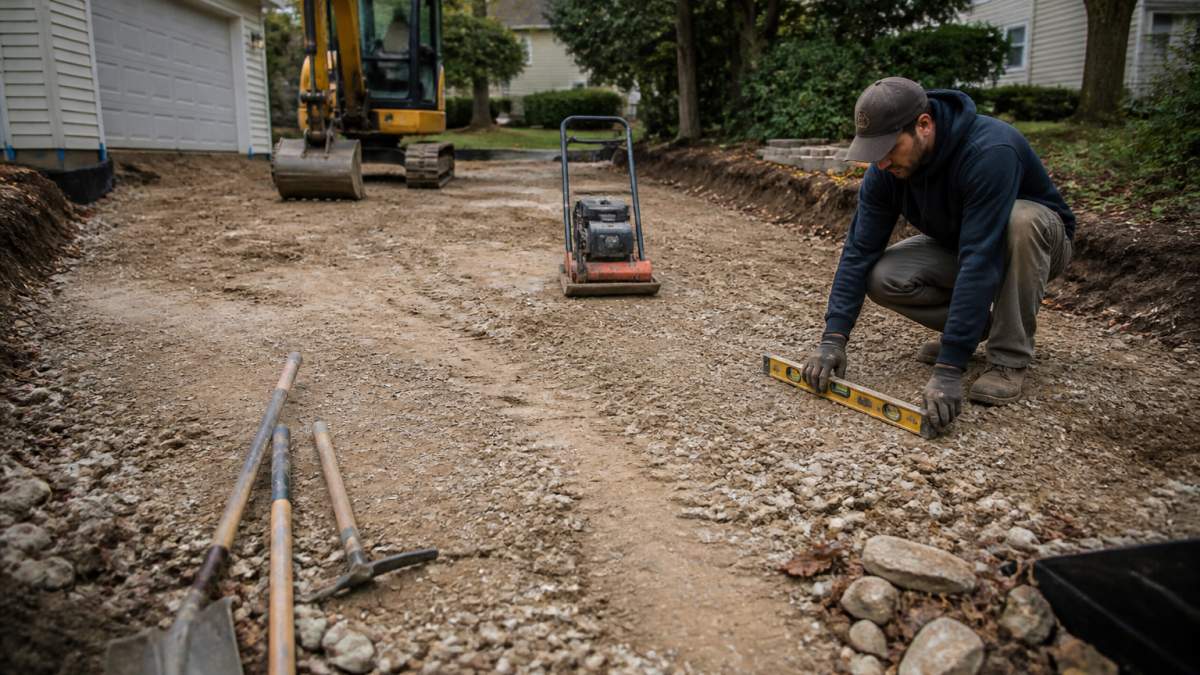
Driveway base preparation is the process of grading, compacting, and stabilizing the soil and gravel layers beneath your driveway surface. Get it wrong, and no surface material will save you.
Two mistakes show up again and again: skipping a soil assessment and compaction, and choosing the wrong base material thickness. Both are invisible once the driveway is finished. Both cause the same result: cracks, sinking, and premature replacement.
Skipping a Soil Assessment and Proper Compaction
Not all soil behaves the same. Clay holds water and expands. Sand drains fast but shifts. Organic soil compacts poorly and will settle under load.
A proper soil assessment tells your contractor what they're building on. From there, they can decide whether the subgrade needs to be removed, replaced, or stabilized before gravel goes down.
Compaction is the other half. Loose soil and gravel will settle under the weight of cars, frost, and time. A common mistake is compacting in one thick layer instead of several thin lifts. Thin lifts compact evenly. Thick lifts hide soft spots.
Choosing the Wrong Base Material Thickness
Base thickness isn't one-size-fits-all. It depends on soil type, drainage, and how the driveway will be used.
- Standard passenger vehicles: a thinner, well-compacted base is often enough.
- Heavy trucks, RVs, or commercial traffic: needs a thicker, more engineered base.
- Poor-draining soil: may need additional gravel or a drainage layer.
A contractor who quotes a base thickness without checking your soil is guessing. Guessing is how driveways fail early.
Driveway Drainage Problems: The Mistakes That Flood Your Investment
Driveway drainage problems are the number one cause of premature driveway failure in our experience. Water that pools on or around a driveway will find its way into the base, soften it, and cause movement.
The fix starts with grading. Every driveway needs a slope that moves water away from your home and toward a drainage point. That could be a swale, a French drain, or a connection to your yard's existing drainage.
Ignoring the Slope and Grading Requirements
A driveway should slope away from your foundation at a gentle, consistent grade. Too flat, and water sits. Too steep, and water moves too fast and erodes the edges.
Homeowners often don't realize that grading isn't just about the driveway surface. It's also about how water moves off the surrounding yard, roof, and downspouts. If those all dump onto the driveway, you're fighting a losing battle.
- Check where your downspouts discharge.
- Note any low spots in the yard near the driveway.
- Look at how water moves during a heavy rain, not a light one.
If you're not sure, ask your contractor to walk the site with you after a storm. A good contractor will point out the problem areas before they quote.
EPA guidance on managing stormwater runoff at home
Driveway Contractor Questions You Must Ask Before Signing
Driveway contractor questions matter more than the quote. A cheap bid from the wrong contractor costs more than a fair bid from the right one.
Here's what we tell homeowners to ask before signing anything:
| Question | Why It Matters |
|---|---|
| How do you assess my soil and drainage? | Reveals whether they plan the base or guess it |
| What base thickness are you using, and why? | Shows if the plan matches your soil and use |
| How do you handle permits and compliance? | Confirms they know local rules |
| What's your curing and joint plan? | Tells you if they understand slab behavior |
| Can I speak with past customers? | Verifies the work, not just the pitch |
Ask for references from projects similar to yours. A driveway with heavy vehicle use needs different planning than a standard residential one. If a contractor can't explain their choices in plain language, that's your answer.
New Driveway Curing Time Mistakes That Weaken the Slab
New driveway curing time is the period when concrete gains strength and moisture leaves the slab. Rush it, and you get a weak surface that cracks and spalls.
Concrete doesn't dry. It cures. That chemical process takes time, and it needs moisture to work. Hot, dry, or windy weather pulls moisture out too fast. Cold weather slows the reaction and can freeze the slab before it sets.
Common curing mistakes:
- Driving on the driveway too soon
- Letting the surface dry out without covering or misting
- Pouring in extreme heat or cold without a plan
- Skipping control joints because "it looks cleaner"
A good contractor will tell you exactly how long to stay off the driveway and how they'll protect it during curing. That timeline depends on weather, mix design, and slab thickness.
Thickness, Joints, and Reinforcement: Mistakes That Lead to Cracks
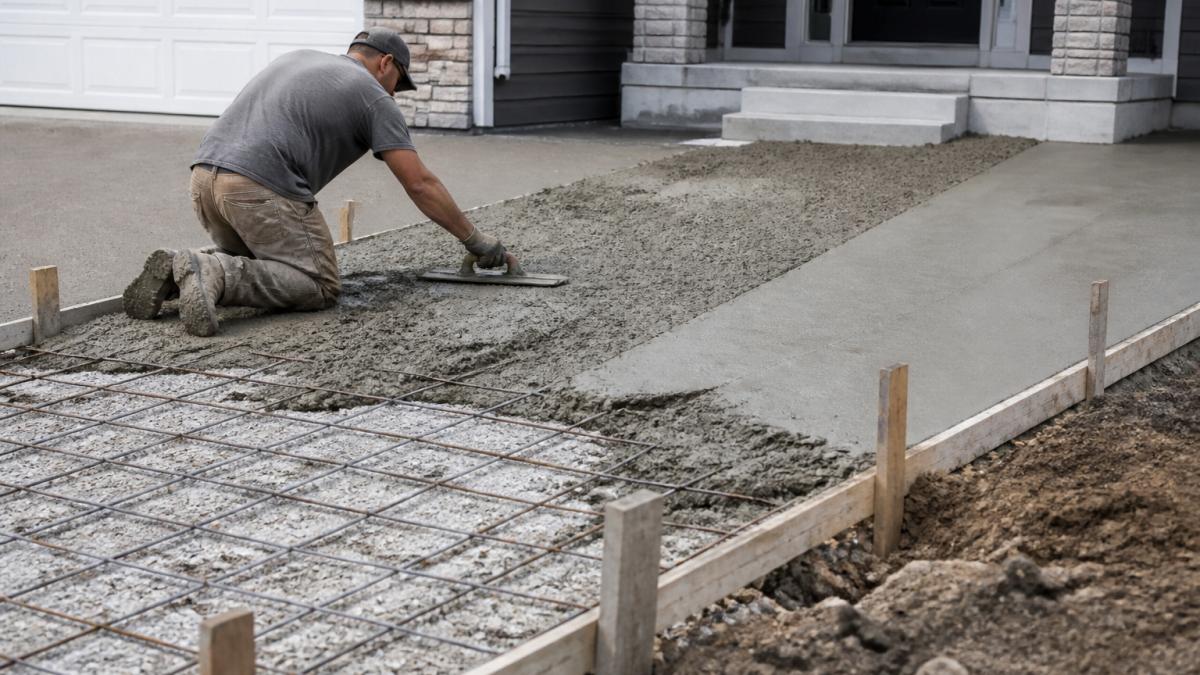
Cracks are the most visible sign of a bad driveway. But they're rarely random. Thickness, joint placement, and reinforcement all work together to control where cracks happen.
- Thickness: too thin for the load, and the slab flexes and cracks.
- Joints: control joints give the concrete a planned place to crack, so it doesn't crack randomly.
- Reinforcement: rebar or mesh helps hold the slab together, but only if it's placed correctly inside the pour.
A common mistake is treating these as separate decisions. They aren't. If the slab is thick but joints are spaced wrong, it cracks. If joints are right but reinforcement sits on the ground, it does nothing.
Asphalt driveways have their own version of this. Compaction, thickness, and edge support decide how the surface holds up. Same principle, different material.
American Concrete Institute guidance on concrete slabs and joints
How Delpres Services Helps Chesterfield Homeowners Avoid These Driveway Construction Mistakes
Chesterfield homeowners deal with the same freeze-thaw cycles that punish driveways across the region. That's why we plan every driveway from the ground up, not the surface down.
We start with a full site review. Soil, drainage, grading, and how you actually use the driveway. From there, we build the base, control the water, and pour or pave with the right thickness and joints for your site.
What sets us apart:
- 20+ years of hands-on experience across residential, commercial, and municipal projects
- One accountable team from excavation to final surface
- Full-scope project management, including permits and compliance
- Multidisciplinary solutions, so drainage, grading, and paving are handled together
If you're comparing quotes and one is much lower, ask what's missing. Usually, it's the base prep or the drainage plan. That's the part you can't see, and the part that decides how long your driveway lasts.
Conclusion
Driveway mistakes are almost never about the surface. They're about the base, the water, and the cure. Fix those three, and your driveway will outlast the neighborhood.
If you're planning a new driveway or replacing one that's already failing, get a contractor who plans the whole system. Delpres Services brings 20+ years of experience, one accountable team, and full-scope project management to every job in Chesterfield and across Metro Detroit.
Book a consultation with Delpres Services and get a driveway built to last, not just poured to look good.
Last Updated: October 6, 2026
Frequently Asked Questions
What are the most common mistakes when building a residential driveway?
The most frequent mistakes are inadequate driveway base preparation, poor drainage grading, pouring concrete too thin, and driving on the surface before the new driveway curing time has passed. Homeowners also skip asking driveway contractor questions about soil conditions, compaction, and joint spacing. Each of these shortcuts shows up later as cracks, settling, or standing water. Getting the prep and drainage right before the pour prevents most of the expensive repairs that follow.
How do you prepare the ground before installing a driveway?
Proper driveway base preparation starts with removing topsoil and organic material, then grading the subgrade to the correct slope away from the house. A compacted aggregate base, typically 4 to 6 inches of crushed stone, goes down in lifts and gets compacted with a plate or roller. The base must be uniform and firm before any concrete or asphalt is placed. Skipping compaction or leaving soft spots is one of the most common residential driveway construction mistakes.
Why is proper driveway drainage important?
Driveway drainage problems cause water to pool against your foundation, under the slab, or at the apron, which leads to settling, cracking, and erosion. A correctly graded driveway slopes away from the house at roughly 1 to 2 percent and directs runoff to a swale, catch basin, or the street. Without that slope, even a well-built driveway will fail prematurely. Drainage is the single most overlooked factor in residential driveway construction.
What should homeowners ask a driveway contractor before construction begins?
Ask about soil testing, base depth, compaction methods, concrete thickness and reinforcement, joint spacing, and the planned new driveway curing time. Request proof of licensing and insurance, and ask for local references from similar projects. Also confirm who pulls permits and how change orders are handled. A contractor who answers these driveway contractor questions clearly and in writing is far less likely to cut corners once work starts.