 ultimate-guide
Municipal Storm Drain Installation Requirements Michigan
Table of Contents
- MS4 Program Overview: How Michigan Regulates Municipal Storm Drains
- Michigan EGLE Stormwater Permit Requirements for Developers and Contractors
- Stormwater Construction Permit Michigan: Step-by-Step Application Checklist
- Stormwater Management Design Standards Michigan: Technical Installation Requirements
- Municipal Storm Drain Installation Requirements: Construction Site Erosion and Sediment Control
- Common Inspection Failure Points and How to Avoid Them
- Cost Factors for Municipal Storm Drain Installation in Michigan
- Conclusion
Last Updated: August 6, 2026
MS4 Program Overview: How Michigan Regulates Municipal Storm Drains
Municipal storm drain installation requirements in Michigan are governed by a layered regulatory framework that most developers and contractors underestimate until they're already behind schedule. At Delpres Services LLC, we've worked through this framework on dozens of Metro Detroit projects, and the biggest source of delays is teams that don't understand how state and local rules interact before breaking ground.
Municipal Separate Storm Sewer System (MS4) is the term used by the U.S. Environmental Protection Agency to describe publicly owned conveyance systems that collect and discharge stormwater runoff. In Michigan, the MS4 program is administered by the Michigan Department of Environment, Great Lakes, and Energy (EGLE) under federal National Pollutant Discharge Elimination System (NPDES) authority.
Michigan's MS4 program requires regulated municipalities to develop and implement Stormwater Management Plans addressing six minimum control measures: public education, public participation, illicit discharge detection and elimination, construction site runoff control, post-construction runoff management, and pollution prevention for municipal operations. According to Michigan EGLE MS4 Program overview, communities operating regulated MS4s must obtain an NPDES permit and demonstrate ongoing compliance with each measure.
For private developers and contractors, your project must comply with both state-level NPDES requirements and the specific stormwater management ordinance adopted by your municipality. Local ordinances often exceed state minimums, and ignoring that distinction is one of the most common and expensive mistakes on Michigan construction sites.
Michigan EGLE Stormwater Permit Requirements for Developers and Contractors
EGLE administers two primary permit pathways that affect storm sewer installation on private development projects. Understanding which one applies to your site determines everything about your compliance timeline.
Who Must Obtain a Permit
Any construction activity that disturbs one or more acres of land, or that is part of a common plan of development disturbing one or more acres, requires coverage under Michigan's Construction General Permit (NPDES). Smaller sites may still require local permits even when state thresholds aren't met.
You need NPDES coverage if your project involves land disturbance of one acre or more, disturbance of less than one acre that is part of a larger common development plan, or any activity that discharges stormwater runoff to a surface water of the state or to an MS4.
Municipalities, counties, and road commissions operating storm sewer infrastructure must hold their own MS4 NPDES permit. Private developers tie into that system and bear responsibility for construction site runoff control during the active construction phase.
NPDES Permit Conditions and Pollutant Discharge Limits
NPDES permit conditions for Michigan construction sites focus on controlling pollutant discharge from disturbed land, particularly sediment, nutrients, and other construction-related contaminants that can degrade surface water quality.
Key NPDES conditions include implementing a written Stormwater Pollution Prevention Plan (SWPPP) before construction begins, installing and maintaining best management practices (BMPs) for erosion and sediment control, conducting regular site inspections and documenting findings, reporting any non-stormwater discharges or permit violations to EGLE, and completing site stabilization with a Notice of Termination once construction is complete.
According to EPA NPDES Construction General Permit requirements, all operators with permit coverage must ensure their SWPPP is site-specific, addresses the unique drainage and soil conditions of the project, and is updated whenever site conditions change materially.
Stormwater Construction Permit Michigan: Step-by-Step Application Checklist
The stormwater construction permit process in Michigan involves parallel tracks at the state and local level. Most project delays occur because applicants submit to one authority while overlooking the other.
State-Level NPDES Application Checklist:
- Confirm whether your project meets the one-acre disturbance threshold
- Identify all operators with stormwater discharge responsibility
- Prepare a site-specific Stormwater Pollution Prevention Plan (SWPPP)
- Include a drainage area map, existing and proposed topography, and impervious surface calculations
- Identify all surface water bodies and MS4 connections within the project drainage area
- Select and document BMPs for erosion control, sediment control, and outfall protection
- Submit a Notice of Intent (NOI) to EGLE before land disturbance begins
- Post the permit coverage number on-site in a visible location
- Establish an inspection and maintenance schedule for all BMPs
Local Municipality Checklist (runs concurrently):
- Contact the local engineering or public works department to identify applicable stormwater ordinance
- Submit site grading and drainage plans for local review and approval
- Obtain local storm sewer connection permit if tying into municipal infrastructure
- Verify local impervious surface limits and detention/retention requirements
- Confirm whether a separate soil erosion and sedimentation control permit is required under Part 91 of Michigan's Natural Resources and Environmental Protection Act (NREPA)
Documents and Plans Required at Submission
State and local reviewers both require a stormwater management plan, but the specific content requirements differ. At the state level, the SWPPP is the primary document. Locally, you'll typically need engineered grading and drainage plans stamped by a licensed Michigan professional engineer.
Core documents required at submission include existing conditions survey with topography and soil data, proposed grading plan showing finished grades and drainage patterns, storm sewer installation plan including pipe sizes and catch basin locations, impervious surface area calculations, hydrologic and hydraulic calculations supporting detention or retention design, erosion and sediment control plan with BMP locations, and maintenance agreement for any permanent stormwater management facilities.
Local vs. State-Level Jurisdiction: Which Rules Apply to Your Site
Michigan's Part 91 Soil Erosion and Sedimentation Control program is administered at the county level by county drain commissioners or local enforcing agencies. This program applies to earth disturbance of one or more acres, or disturbance within 500 feet of a lake or stream regardless of acreage. It operates independently of the state NPDES CGP, meaning you may need both permits simultaneously.
Local municipalities add another layer through their own stormwater management ordinances, which often set more stringent runoff volume controls, water quality treatment standards, and impervious surface limits than state minimums. In cases of conflict, the stricter standard governs.
Identify all three jurisdictions (state NPDES, county Part 91, local municipality) at the project outset, not after design is complete.
Stormwater Management Design Standards Michigan: Technical Installation Requirements
Technical design standards for Michigan storm drain infrastructure are where regulatory compliance meets engineering precision. Getting the design wrong at this stage creates inspection failures, costly rework, and potential liability for downstream flooding or water quality impacts.
Storm Sewer Installation Standards: Pipe, Catch Basin, and Outfall Specifications
Storm sewer installation in Michigan must conform to standards set by EGLE, the Michigan Department of Transportation (MDOT) for projects affecting state roads, and local municipal engineering specifications. Most Metro Detroit municipalities reference the Southeast Michigan Council of Governments (SEMCOG) stormwater design guidelines as a baseline.
Key technical specifications for storm drain infrastructure include:
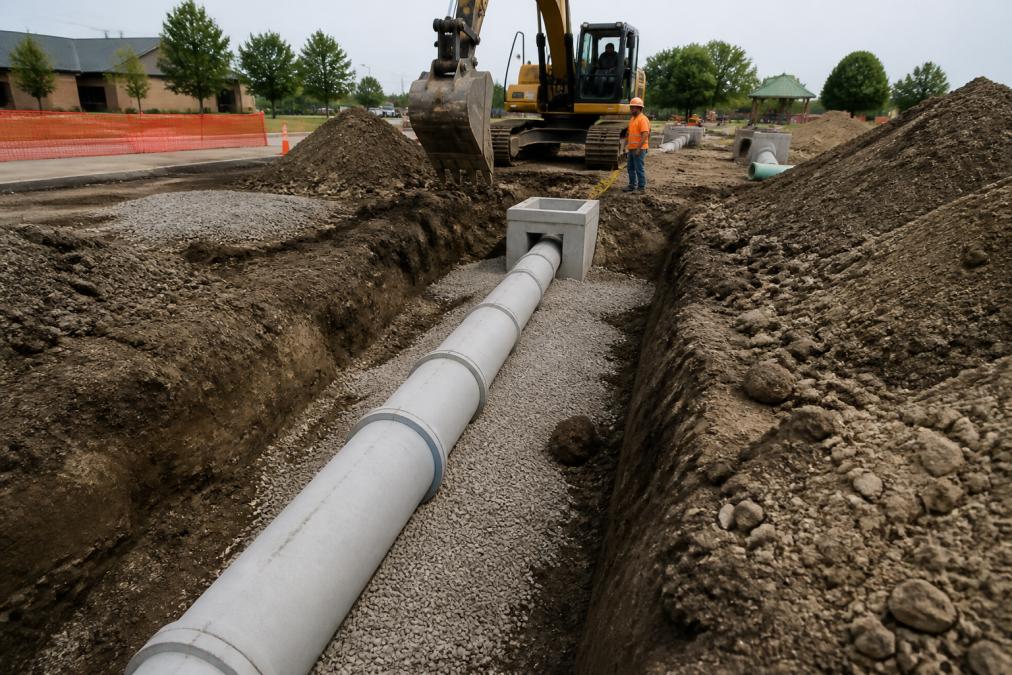
Pipe and Conduit: Reinforced concrete pipe (RCP) or high-density polyethylene (HDPE) are the most commonly accepted materials for municipal storm sewer installation. Minimum pipe diameter for public storm sewers is generally 12 inches; local standards may require larger minimums on collector systems. Pipe bedding, haunching, and backfill must meet compaction specifications to prevent settlement and joint separation. Appurtenant structures (manholes, junction boxes) must be installed at grade changes, direction changes, and maximum spacing intervals per local standards.
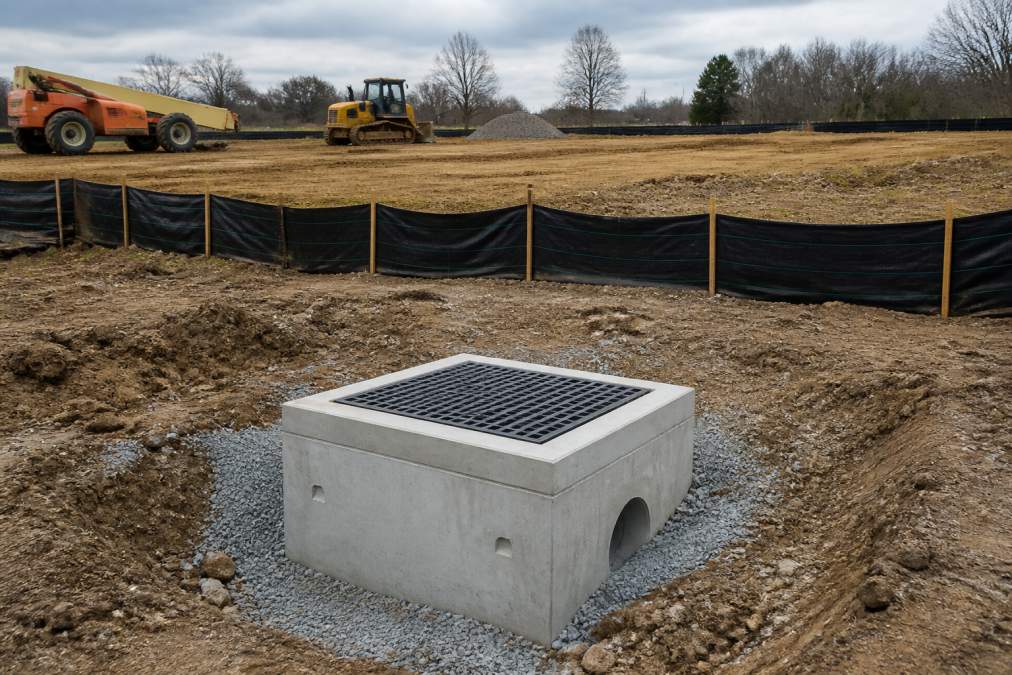
Catch Basins: Catch basins must be sized to handle the design storm event, typically the 10-year or 25-year storm depending on drainage area and land use. Sump depth requirements vary by municipality but commonly require a minimum 18-inch sump below the lowest outlet pipe invert to trap sediment. Grate selection must account for traffic loading, ADA requirements where applicable, and hydraulic inlet capacity.
Outfall Structures: All outfalls discharging to surface water require EGLE authorization under Part 31 of NREPA in addition to NPDES coverage. Outfall structures must include energy dissipation to prevent scour at the discharge point. Riprap aprons or concrete headwalls are standard at pipe outfalls; design must address the velocity of the design storm discharge.
According to Michigan EGLE Part 31 Water Resources Protection guidance, any new or modified outfall to a regulated water of the state requires a separate permit application and may trigger wetland review under Part 303 of NREPA.
Infiltration, Impervious Surface Limits, and Runoff Management
Post-construction stormwater management is the piece that catches developers off guard most often. Michigan's MS4 communities are required to implement post-construction runoff controls that address both volume and water quality, and local ordinances frequently mandate on-site infiltration, detention, or retention as a condition of site plan approval.
| Design Approach | Primary Function | Best Suited For |
|---|---|---|
| Detention basin | Peak flow attenuation | Large sites with space for surface storage |
| Retention pond | Volume reduction + water quality | Sites near surface water with pollutant concerns |
| Infiltration basin/trench | Groundwater recharge | Sites with permeable soils, low water table |
| Bioretention (rain garden) | Water quality + volume | Smaller sites, urban infill, parking lot edges |
| Underground detention | Volume control in constrained sites | High-density commercial, limited land area |
Impervious surface limits vary by municipality and zoning district. Many Metro Detroit communities cap impervious coverage at a percentage of the total lot area and require compensatory stormwater management for any coverage exceeding the baseline. Hydrologic management calculations must demonstrate that post-development runoff rates and volumes do not exceed pre-development conditions for the design storm events specified in the local ordinance.
Municipal Storm Drain Installation Requirements: Construction Site Erosion and Sediment Control
Erosion and sediment control is the most actively inspected phase of any storm drain installation project in Michigan. Inspectors check whether controls are present, properly installed, maintained, and adequate for current site conditions.
Minimum required BMPs for Michigan construction sites include:
Silt fence installed at the downslope perimeter of all disturbed areas, inlet protection on all existing and newly installed catch basins within or adjacent to the disturbed area, stabilized construction entrance to prevent tracking of sediment onto public roads, temporary seeding or mulching on areas that will remain disturbed for more than 14 days, and sediment basin or trap where drainage area to a single discharge point exceeds 10 acres.
The most common inspection failure point is inlet protection. Contractors install it at the start of the project and then fail to maintain it after significant rain events. A clogged or collapsed inlet protection device provides essentially no sediment control and will result in a violation notice.
Soil disturbance must be sequenced to minimize the area of exposed ground at any given time. Phased grading, where only the active work area is disturbed while the rest of the site remains stabilized, is both a regulatory expectation and a practical risk management tool.
Common Inspection Failure Points and How to Avoid Them
Michigan construction site inspections under Part 91 and the NPDES CGP focus on a predictable set of failure points. Knowing them in advance is the difference between a clean inspection and a stop-work order.
The most frequently cited violations:
-
SWPPP not on site or not current. The SWPPP must be kept at the project site and updated whenever site conditions change. An outdated SWPPP that doesn't reflect actual site drainage patterns is a violation even if the physical controls are adequate.
-
Inlet protection absent or ineffective. Filters and barriers around catch basins must be inspected after every storm event of 0.5 inches or more and repaired or replaced as needed.
-
Stabilized construction entrance not maintained. Tracking mud onto public roads is a Part 91 violation. The entrance must be maintained throughout the project.
-
Disturbed areas not stabilized within required timeframes. Michigan requires temporary stabilization within 14 days of the last disturbance for areas that won't be re-disturbed. Permanent stabilization must follow final grading within the timeframe specified in the permit.
-
Discharge from site without treatment. Any visible turbid discharge leaving the site boundary or entering a storm drain is a reportable event. Inspectors document it with photographs.
-
No inspection records. The NPDES CGP requires documented site inspections at specified intervals. Missing records are treated as non-compliance even if physical controls were functioning.
Cost Factors for Municipal Storm Drain Installation in Michigan
Cost estimation for storm drain installation in Michigan involves more variables than most project budgets account for. The physical construction is only part of the picture. Regulatory compliance, design engineering, and inspection-related rework all carry real costs that belong in the project budget from day one.
Primary cost drivers include:
- Site conditions: Soil type, groundwater depth, and existing subsurface utilities directly affect excavation difficulty, pipe bedding requirements, and installation productivity.
- Pipe material and diameter: Larger diameter reinforced concrete pipe costs more per linear foot than smaller HDPE pipe, but local specifications may require specific materials for public system connections.
- Detention or retention requirements: If local ordinance requires on-site stormwater management, the design, excavation, and construction of detention basins or underground systems adds substantial cost beyond the basic drainage system.
- Permit and engineering fees: State NPDES NOI fees, county Part 91 permit fees, and local plan review fees vary by jurisdiction and project size. Engineering fees for SWPPP preparation and stamped drainage plans are a fixed cost regardless of project scale.
- Inspection and testing: Pipe deflection testing, mandrel testing for flexible pipe, and video inspection of completed storm sewers are commonly required by municipalities before accepting infrastructure into public ownership.
- Rework from failed inspections: A single inspection failure requiring corrective work and re-inspection can add days to the schedule and thousands of dollars in labor.
Delpres Services LLC handles full-scope storm sewer installation projects in Metro Detroit, including permit coordination, SWPPP preparation, and compliance management. For accurate project-specific cost estimates, contact us directly for a consultation.
For a broader understanding of how federal stormwater regulations interact with state programs, the EPA's National Menu of Best Management Practices for Stormwater provides detailed technical guidance on BMP selection and design that applies directly to Michigan projects.
Storm drain compliance in Michigan is genuinely complex, and the cost of getting it wrong, whether through missed permits, failed inspections, or undersized infrastructure, falls entirely on the developer and contractor. Delpres Services LLC brings 20+ years of hands-on experience with Metro Detroit storm sewer installation, permit coordination, and full-scope site development to every project. From SWPPP preparation to final pipe testing and municipal acceptance, our team manages the compliance process end to end so you don't face surprises at inspection. Book a consultation with Delpres Services LLC to get accurate project planning and dependable workmanship from start to finish.
Frequently Asked Questions
Who is required to obtain a stormwater permit in Michigan?
Any construction project that disturbs one or more acres of land in Michigan must obtain a National Pollutant Discharge Elimination System (NPDES) permit for stormwater runoff through the Michigan Department of Environment, Great Lakes, and Energy (EGLE). Projects smaller than one acre may still require a permit if they are part of a larger common plan of development. Municipal separate storm sewer system (MS4) operators, including cities, counties, and road agencies, must also hold individual MS4 permits.
What is an MS4 permit and why does it matter for construction?
An MS4 permit is an NPDES permit issued to operators of municipal separate storm sewer systems, covering storm drain infrastructure that discharges stormwater to surface water. For construction contractors, it matters because work within or connecting to an MS4 system must comply with the municipality's stormwater management ordinance and best management practices. Failing to meet MS4 requirements can result in stop-work orders, fines, and mandatory corrective measures that delay your project timeline significantly.
What are the minimum design requirements for storm sewers in Michigan?
Michigan's stormwater management design standards, administered through EGLE and local ordinances, generally require storm sewer pipes to be sized using hydraulic calculations based on design storm frequency, typically a 10-year or 25-year storm event. Catch basins, conduits, outfalls, and appurtenant structures must meet material and installation specifications set by the local municipality or county drain commissioner. Infiltration systems must account for soil permeability, groundwater protection setbacks, and impervious surface ratios defined in the applicable local ordinance.
How do local municipal ordinances differ from state stormwater regulations in Michigan?
Michigan state regulations, primarily through EGLE's NPDES program, set the baseline for stormwater runoff control and pollutant discharge limits. Local municipal ordinances can be, and frequently are, more restrictive than state rules. A municipality may impose stricter impervious surface limits, require on-site retention or infiltration, mandate specific pipe materials, or require pre-approval from the county drain commissioner. Developers must satisfy both levels of oversight, and when local rules are stricter, local rules govern the project.
What drainage laws apply to private property in Michigan?
Michigan's Drain Code (Public Act 40 of 1956) governs drainage across both public and private land. Property owners cannot obstruct, redirect, or discharge stormwater in ways that damage neighboring properties. Private development that alters drainage patterns may require approval from the county drain commissioner. Local zoning and site plan review processes also evaluate how new impervious surfaces affect downstream stormwater runoff. Violations can result in civil liability to adjacent landowners as well as regulatory enforcement actions.
What can I build without a stormwater permit in Michigan?
Projects that disturb less than one acre of land and are not part of a larger common plan of development generally do not require an NPDES stormwater construction permit from EGLE. However, local municipal permits, grading permits, or drain commissioner approvals may still apply regardless of disturbance size. Any project connecting to a municipal storm sewer system typically requires a connection permit from the local municipality or road agency. Always verify requirements with your local building department and county drain commissioner before starting site work.
This article was written using GrandRanker