 ultimate-guide
Benefits of Using Integrated Construction Services
Table of Contents
- What Integrated Construction Services Actually Cover
- Benefits of Single-Source Construction: Fewer Handoffs, Fewer Headaches
- How Integrated Services Improve Communication on Site
- Construction Project Management Best Practices That Keep Budgets in Check
- Choosing a Site Development Contractor in Metro Detroit
- Common Challenges and How an Integrated Team Solves Them
- Conclusion
- Frequently Asked Questions
Last Updated: September 15, 2026
What Integrated Construction Services Actually Cover
Integrated construction services bundle excavation, underground utilities, concrete, asphalt, and site preparation under one contract instead of splitting them across five different companies. That single scope is the core benefit, and it is why so many Metro Detroit property owners are rethinking how they hire.
Most people picture a contractor as one trade: the excavator, the paver, the concrete crew. Integrated construction flips that model. One team handles the full sequence, from breaking ground to the final layer of asphalt.
From Excavation to Asphalt: The Full Scope
A genuinely integrated contractor covers the entire site development chain:
- Excavation, grading, and site preparation
- Storm and sanitary sewer, water main, and underground utilities
- Concrete flatwork, foundations, footings, and retaining walls
- Asphalt paving, driveways, and parking lots
- Drainage, demolition, and final site restoration
The value shows up in the handoffs. When the same crew that dug the trench also sets the utility, there is no waiting on a subcontractor's calendar and no finger-pointing when a grade is off. The American Society of Civil Engineers infrastructure report card has repeatedly flagged how fragmented coordination drives up project cost and delay across U.S. site work.
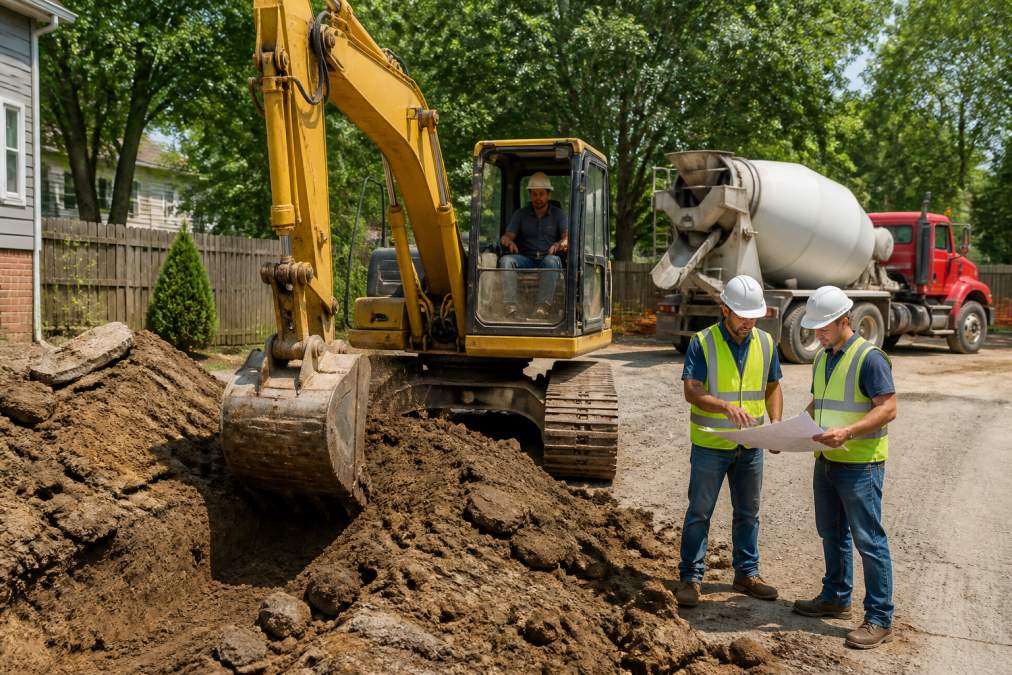
Benefits of Single-Source Construction: Fewer Handoffs, Fewer Headaches
The biggest advantage of single-source construction is accountability. When one company owns every phase, there is no gap between trades where problems hide.
Ask anyone who has managed a major exterior project. The delays rarely come from the work itself. They come from the seams, the week lost waiting for the utility crew, the rework when the concrete pour doesn't match the excavation plan. Integrated teams close those seams by design.
One Contract, One Point of Accountability
With separate contractors, a drainage failure becomes a debate: was it the grading or the pipe? With one contract, that debate disappears. The same team that graded the site installed the drainage, so responsibility is unambiguous.
That clarity has a real operational payoff. Delpres Services LLC builds its entire model around it, keeping one accountable team on a project from the first survey stake to the last load of asphalt. No relay race between vendors, no gaps where a schedule slips.
How Integrated Services Improve Communication on Site
Communication improves because there is one chain of command. The estimator who priced the job talks to the crew that builds it, and the project manager answers to the owner directly.
On a fragmented job, information dies at every handoff. The excavator's field notes never reach the concrete foreman. The utility crew's as-built measurements sit in a truck. Integrated teams share one set of plans, one schedule, and one point of contact, so a change in the field reaches everyone who needs it the same day.
That matters most when conditions shift. Underground surprises are common on older Metro Detroit properties: abandoned footings, unmapped lines, soil that won't drain (the EPA). A single team can adjust the plan on the spot. Five separate companies cannot.
Construction Project Management Best Practices That Keep Budgets in Check
Strong construction project management best practices share one trait: they resolve scope before the first shovel hits the ground. Integrated teams apply this discipline across every trade at once.
Here is a practical checklist worth running on any major site project:
- One written scope covering every phase, from excavation through final paving
- A single schedule with dependencies mapped between trades
- Permit and compliance responsibility assigned to one party
- A defined change-order process with written approval before extra work begins
- Weekly progress reporting against the original budget line items
- A closeout plan for inspections, as-builts, and final grading
The change-order step is where budgets quietly fail. When a project is split across vendors, each one bills separately for surprises, and nobody owns the total. A single contractor prices the whole sequence and absorbs the coordination cost internally.
Choosing a Site Development Contractor in Metro Detroit
Choosing a site development contractor in Metro Detroit comes down to three things: scope, references, and local compliance knowledge. A contractor who only does one trade will hand your project off the moment the phase changes.
Local knowledge is not a marketing line here. Permitting, soil conditions, and drainage requirements vary across the region, and a contractor who works regularly in Chesterfield and the surrounding communities already knows what the local building department expects before the application is filed (michigan.gov).
At Delpres Services LLC, that local footing is backed by more than two decades of hands-on work across residential, commercial, industrial, and municipal projects. The team manages permits and compliance as part of the scope, so the owner is not chasing approvals between trades.
When you compare contractors, use a simple screen:
| What to Check | Why It Matters | Red Flag |
|---|---|---|
| Full scope under one contract | Fewer handoffs, clear accountability | Scope stops at one trade |
| Local permit experience | Fewer delays at inspection | "We'll figure it out" |
| Verifiable references | Proof of finished work | No local references |
| Written change-order process | Protects your budget | Verbal approvals only |
| Single point of contact | Faster decisions on site | Rotating project managers |
If you are searching for a site development contractor near me, ask for references from projects in your own city and talk to those owners directly. Past clients will tell you more in ten minutes than any brochure will.
Common Challenges and How an Integrated Team Solves Them
Most construction challenges trace back to coordination, and that is exactly what integration fixes. Weather delays, permit holds, and surprise site conditions are manageable when one team controls the response.
Take a typical backyard renovation with an inground pool. A homeowner lines up a pool designer, a separate excavation crew, and a concrete company. The pool shell is set, then the concrete crew is booked out three weeks. The excavation crew has already left. The site sits open, exposed to rain, and the schedule slips.
An integrated team sequences those phases on one calendar. Excavation, pool construction, concrete flatwork, drainage, and final grading happen in the right order because the same project manager controls all of them. That is the difference between a finished backyard and an abandoned one.
Conclusion
Every construction project carries risk, and most of it lives in the space between trades. Splitting a major site project across multiple vendors multiplies that risk with every handoff.
Delpres Services LLC removes those handoffs. One accountable team manages the full scope, from excavation and underground utilities through concrete, asphalt, and final site preparation, with permits and compliance handled as part of the job. For homeowners, developers, and property managers across Metro Detroit, that means one contract, one schedule, and one company that owns the outcome.
Get started with Delpres Services LLC and keep your next project on budget, on schedule, and under one roof.
Frequently Asked Questions
What are integrated construction services?
Integrated construction services bring multiple trades under one contract: excavation, underground utilities, concrete, asphalt, and site work. Instead of hiring separate crews for each phase, you work with one company that manages the entire scope. This reduces scheduling conflicts and keeps quality consistent from start to finish. For example, Delpres Services handles everything from storm sewer installation to driveway paving, so you never have to coordinate between multiple contractors.
How does integrated project delivery improve construction efficiency?
Integrated project delivery improves efficiency by eliminating the gaps between trades. When one team controls excavation, utilities, and concrete, they can sequence work without waiting for another contractor to show up. That means fewer idle days and faster project completion. On a typical site development project in Metro Detroit, this can shave weeks off the schedule because there is no back-and-forth over who is responsible for what.
What are the cost benefits of using a single-source construction contractor?
Single-source construction reduces costs in three ways: fewer change orders, less downtime, and lower administrative overhead. When one company manages the entire project, there is less chance of miscommunication that leads to rework. You also avoid paying multiple mobilization fees. Delpres Services provides transparent pricing and a detailed scope before work begins, so you know what you are paying for. For a specific quote, contact Delpres directly.
How do integrated services improve communication on construction sites?
With integrated services, all trades report to the same project manager. That means daily updates, one schedule, and a single point of contact for questions. If a concrete crew needs to wait for utility work, the project manager adjusts the sequence immediately. Homeowners and developers get consistent answers instead of chasing down different subcontractors. This clarity is especially valuable for complex projects like pool installations or commercial parking lots.