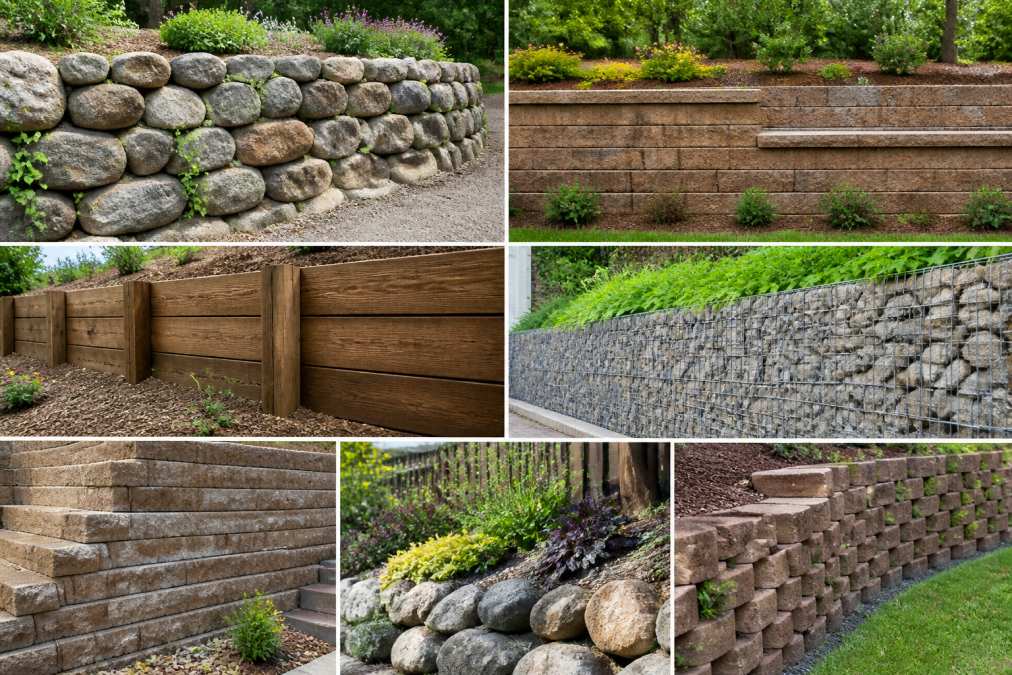
 listicle
7 Retaining Wall Alternatives to Poured Concrete
Table of Contents
- Why Look Beyond Traditional Poured Concrete?
- Retaining Wall Cost Comparison: Material vs. Installation
- 1. Segmental Retaining Wall Blocks (Keystone, Techo-Bloc)
- 2. Large-Format Precast Blocks (Redi-Rock, MagnumStone)
- 3. Natural Stone and Boulder Walls
- 4. Gabion Walls (Wire Cages and Stone)
- 5. Concrete Masonry Units (CMU Blocks)
- 6. Timber and Railroad Ties
- Which Retaining Wall Alternative Is Right for Your Property?
- Frequently Asked Questions
Last Updated: September 7, 2026
Poured concrete is the default choice for retaining walls, but it is rarely the smartest one, and retaining wall alternatives now outperform it on cost, speed, and appearance. The material costs are high, the curing time slows down your project, and the plain gray finish forces you into an aesthetic you may not want. Delpres Services LLC brings over 20 years of hands-on expertise to retaining wall projects across Metro Detroit, and we routinely steer homeowners toward better options. Retaining wall alternatives now outperform poured concrete on cost, speed, and appearance.
The seven alternatives below range from interlocking blocks you can install in a weekend to engineered precast systems that handle commercial loads. A retaining wall alternative is any structural system that holds back soil without relying on poured-in-place concrete. We will walk through each option with honest pros and cons, plus the installation considerations that most guides miss.
Why Look Beyond Traditional Poured Concrete?
The biggest misconception is that poured concrete is the strongest option. In practice, poured concrete walls require extensive formwork, steel reinforcement, and a 28-day cure before backfill can be placed against them (cement.org).
Poured concrete also handles drainage poorly. Without proper weep holes and aggregate behind the wall, hydrostatic pressure builds up and eventually cracks the structure. The failure point is almost always the drainage system, not the concrete itself.
Poured concrete also demands skilled labor for forming and finishing, and any mistake means tearing out and repouring entire sections. Modular systems, by contrast, let you replace individual units if damage occurs.
Retaining Wall Cost Comparison: Material vs. Installation
Material cost tells you very little about the final price of a retaining wall. Installation labor, excavation, drainage stone, and backfill often exceed the cost of the wall units themselves.
The table below summarizes how the seven alternatives compare across the factors that actually determine your total investment:
| Wall System | Installation Complexity | Best Wall Height | Primary Cost Driver |
|---|---|---|---|
| Segmental Blocks | Moderate, DIY possible | Up to 4 ft without geogrid | Block quantity and base preparation |
| Large-Format Precast | Heavy machinery required | 6 ft and taller | Crane or excavator rental |
| Natural Stone/Boulders | Specialized equipment | Varies by stone size | Material sourcing and delivery |
| Gabion Cages | Labor-intensive filling | Up to 6 ft | Wire mesh and stone fill |
| CMU Blocks | Moderate, needs finishing | Up to 5 ft when reinforced | Core filling and surface finish |
| Timber Ties | Low, DIY friendly | Up to 3 ft | Lumber treatment quality |
Retaining wall cost comparison depends heavily on access to your site. A backyard in Chesterfield with narrow gate access will add delivery and equipment costs that a wide-open commercial lot will not. Get a site-specific quote before you commit to a material, and ask the contractor to itemize excavation and drainage separately from the wall units.
1. Segmental Retaining Wall Blocks (Keystone, Techo-Bloc)
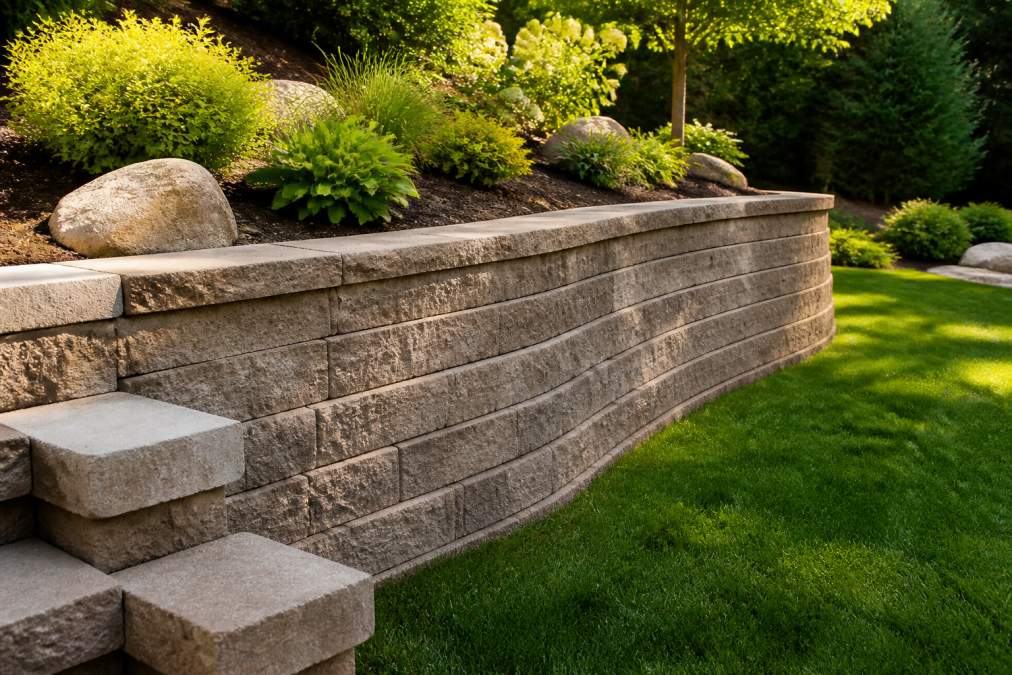
Segmental retaining wall blocks are the most popular alternative to poured concrete for good reason. These interlocking concrete units stack without mortar, using either a pin system or a lip on the block itself to lock each course in place.
Installation is straightforward: excavate a level base trench, compact a gravel base, and lay the first course carefully. Each subsequent course steps back slightly, creating a wall that leans into the slope it holds.
Techo-Bloc's Mini-Creta system offers a double-sided finish for freestanding garden walls and raised planters. Keystone's pin system provides reliable alignment and shear strength. Both brands offer textures and colors that read as natural stone from a distance.
The honest limitation is height: once you exceed roughly 4 feet, you need geogrid reinforcement layers extending back into the soil. For standard residential grading in Chesterfield, though, this system delivers the best balance of price, durability, and appearance.
2. Large-Format Precast Blocks (Redi-Rock, MagnumStone)
Large-format precast blocks are the answer when you need a wall that looks like natural stone but must handle serious structural loads. Redi-Rock produces massive solid blocks that rely on their own weight for stability, while MagnumStone uses a hollow-core design that cuts material costs.
These blocks are significantly larger than segmental units, typically weighing over a ton each. That weight is the entire engineering concept: a gravity wall that resists soil pressure through sheer mass.
The trade-off is installation. Every unit requires an excavator or crane, so the project needs equipment access and an operator who knows how to set blocks level. This is not a DIY project.
MagnumStone's hollow-core design deserves special attention for commercial work. The cores reduce shipping weight, and once stacked, you fill them with concrete and reinforcing steel. The result performs like poured concrete but installs faster because no formwork is required.
For tall walls over 6 feet, large-format precast is often the most cost-effective engineered solution, competitive with poured concrete once you account for the labor saved by eliminating forms.
3. Natural Stone and Boulder Walls
Natural boulder walls bring something no manufactured product can replicate: uniqueness. A skilled operator can create a wall that looks like it has been part of the landscape for centuries.
The engineering principle is simple. Large boulders, typically 2 to 4 feet in diameter, are placed with their longest dimension extending back into the slope. Weight and interlocking placement hold the soil, with no mortar, reinforcement, or drainage pipe required in most cases.
This is the most forgiving retaining wall alternative when it comes to drainage. Water flows through the gaps between boulders, eliminating hydrostatic pressure entirely.
The downsides are practical rather than structural. Boulders are extremely heavy, requiring specialized equipment, and sourcing quality stone in quantity can be challenging, with delivery costs rising quickly with distance.
Natural boulder walls work best for slope stabilization and naturalistic landscapes. For a Chesterfield property with an existing wooded slope, boulders blend into the environment in a way that concrete never will.
4. Gabion Walls (Wire Cages and Stone)
Gabion walls are wire mesh baskets filled with stone, stacked to create a retaining structure. They look like modern art installations, a favorite for contemporary landscape design, but their real strengths are structural.
The wire cages are permeable, so water flows through rather than building up behind the wall. The mesh flexibility also allows the wall to absorb minor ground movement without cracking, a significant advantage in areas with expansive clay soils.
Installation is labor-intensive but requires no specialized equipment. You assemble the flat-packed cages, place them on a level base, and fill them with stone, packing each cage by hand or with a small excavator to achieve proper density.
Gabion walls are excellent for erosion control along waterways and sites where drainage is a persistent problem. The stone fill can often be sourced on-site, reducing material costs. The wire mesh requires galvanized or PVC-coated steel to resist corrosion, so confirm the cage specification before purchase.
5. Concrete Masonry Units (CMU Blocks)
Concrete masonry units, commonly called CMU blocks or cinder blocks, are the budget workhorse of the retaining wall world. These standardized blocks are inexpensive, universally available, and structurally sound when properly reinforced.
The catch is that a bare CMU wall looks like a construction site. The gray blocks require a surface finish, typically stucco, veneer stone, or a parge coat, to be acceptable in a residential setting.
Structurally, CMU walls are built like miniature concrete walls. Blocks are laid in a running bond pattern with mortar, and vertical cells are filled with concrete and reinforcing steel, matching the strength of poured concrete at a lower material cost.
The labor requirement is the hidden expense. Laying CMU blocks is skilled masonry work, and the wall must be built perfectly level and plumb. For a small utility wall behind a commercial building, CMU is the smart choice. For a visible residential wall, the cost of finishing often pushes the total price above segmental blocks.
6. Timber and Railroad Ties
Timber retaining walls offer the lowest upfront cost and simplest installation of any option here. Pressure-treated landscape timbers or railroad ties are stacked like logs and anchored with steel spikes or rebar.
The appeal is immediate: a weekend project that costs a fraction of any concrete system. For a low wall under 3 feet that defines a garden bed or holds back a small slope, timber gets the job done.
The honest limitation is lifespan. Even pressure-treated lumber degrades over time, especially in Michigan's wet, freeze-thaw winters. Railroad ties carry the additional concern of creosote treatment. Expect to replace a timber wall within 10 to 15 years, compared to the 50-plus year lifespan of a properly built concrete system (fs.usda.gov).
Timber walls also require careful drainage. The wood must not sit in constant moisture, or rot accelerates dramatically. A gravel backfill and a way for water to escape are essential.
For a permanent solution, timber is rarely the right call. For a temporary fix or a purely decorative border, it remains the most accessible retaining wall alternative available. If you are in Chesterfield and considering timber for a larger slope, talk to a professional first.
Which Retaining Wall Alternative Is Right for Your Property?
The decision comes down to three questions: how tall is the wall, what is the soil and drainage situation, and how long do you want the wall to last? A 2-foot garden border calls for timber or segmental blocks. A 6-foot slope stabilization project demands large-format precast or an engineered segmental system with geogrid.
Retaining wall permit requirements in Michigan vary by municipality, and many local building departments require engineered plans for walls over 4 feet tall. Check with your local building office before committing to a system. A full-service contractor handles this compliance work as part of the project.
For most homeowners in Metro Detroit, segmental retaining wall blocks deliver the best combination of cost, durability, and curb appeal. For commercial and municipal projects where failure is not an option, large-format precast systems like Redi-Rock and MagnumStone provide engineered certainty.
The installation considerations we have covered, drainage above all, apply to every system. A wall without proper drainage will fail regardless of the material you choose.
Choosing the right retaining wall alternative requires honest assessment of your site conditions, your budget, and your long-term goals. Delpres Services LLC brings over 20 years of hands-on expertise to retaining wall projects across Metro Detroit, from simple residential garden walls to engineered commercial structures. Our one accountable team handles excavation, drainage, and installation from start to finish, and we manage permits and compliance so you do not have to. Book a consultation with Delpres Services LLC and get a site-specific recommendation for your Chesterfield property.
Frequently Asked Questions
What is the cheapest alternative to a concrete retaining wall?
In terms of upfront material cost, timber railroad ties and standard CMU blocks are typically the most budget-friendly retaining wall alternatives. However, the cheapest option is not always the most cost-effective over time. Timber may need replacement sooner in Michigan's freeze-thaw climate, while CMU requires a stucco or veneer finish to look good. Consider the 20-year cost, including maintenance and replacement, when comparing against segmental blocks or precast concrete.
Are natural stone retaining walls better than concrete?
Natural stone offers a unique, organic look and excellent durability that many homeowners prefer over poured concrete. It is not necessarily 'better' in structural terms, but it excels in aesthetics and blends into natural landscapes. The main trade-offs are a higher material cost and the need for specialized equipment to place large boulders. For smaller residential walls, segmental blocks offer a similar natural appearance with easier installation and more predictable pricing.
Do I need a permit for a retaining wall in Chesterfield, MI?
Most likely, yes. Retaining wall permit requirements Michigan homeowners must follow typically depend on the wall's height. In Chesterfield and across Michigan, walls over four feet tall, or those that support a surcharge, almost always require a permit and engineered plans. Even shorter walls may need a permit if they affect drainage or are near a property line. Always check with Chesterfield Township's building department before starting excavation.
Which retaining wall material lasts the longest?
When installed correctly, large-format precast systems like Redi-Rock and MagnumStone, along with natural boulder walls, have the longest lifespans, often exceeding 75 years. Poured concrete also lasts decades but is prone to cracking from freeze-thaw cycles if not reinforced properly. The longevity of any wall depends heavily on proper drainage and a correct base. A poorly built wall will fail regardless of the material's inherent durability.
Can I use timber for a retaining wall in Michigan's climate?
Yes, but you should expect a shorter lifespan than concrete or stone. Michigan's freeze-thaw cycles and wet soil cause untreated timber to rot and shift quickly. Pressure-treated lumber resists decay but may warp or crack over time. A timber wall is best for low-height garden borders under three feet. For anything taller that holds back a driveway or slope, segmental blocks or precast concrete offer far better long-term structural performance.