 blog
blog
Natural Stone vs Artificial Turf for Backyards: 2026 Guide
Table of Contents
- Natural Stone vs Artificial Turf for Backyards: What Actually Decides It
- Natural Stone and Artificial Turf: Side-by-Side Comparison
- Natural Stone Patio Pros and Cons
- Artificial Turf Installation Cost: What Drives the Number
- Artificial Turf Drainage and Maintenance
- Backyard Pavers vs Artificial Turf: Matching Surface to Use
- Michigan Winters, Permits, and Base Prep: What Both Options Demand
- Conclusion: Choosing the Right Backyard Surface
- Frequently Asked Questions
Last Updated: October 4, 2026
Natural Stone vs Artificial Turf for Backyards: What Actually Decides It
Choosing between natural stone vs artificial turf for backyards comes down to one question: how do you actually use the space? Natural stone is a hardscape surface built for foot traffic, furniture, and drainage. Artificial turf is a softscape surface built for bare feet and low upkeep. Most homeowners in Chesterfield and across Metro Detroit pick wrong because they compare looks instead of function. This guide from Delpres Services LLC breaks down cost drivers, drainage, maintenance, and what our Michigan climate does to both surfaces over time.
Here's the honest version: neither option is "better." They solve different problems.
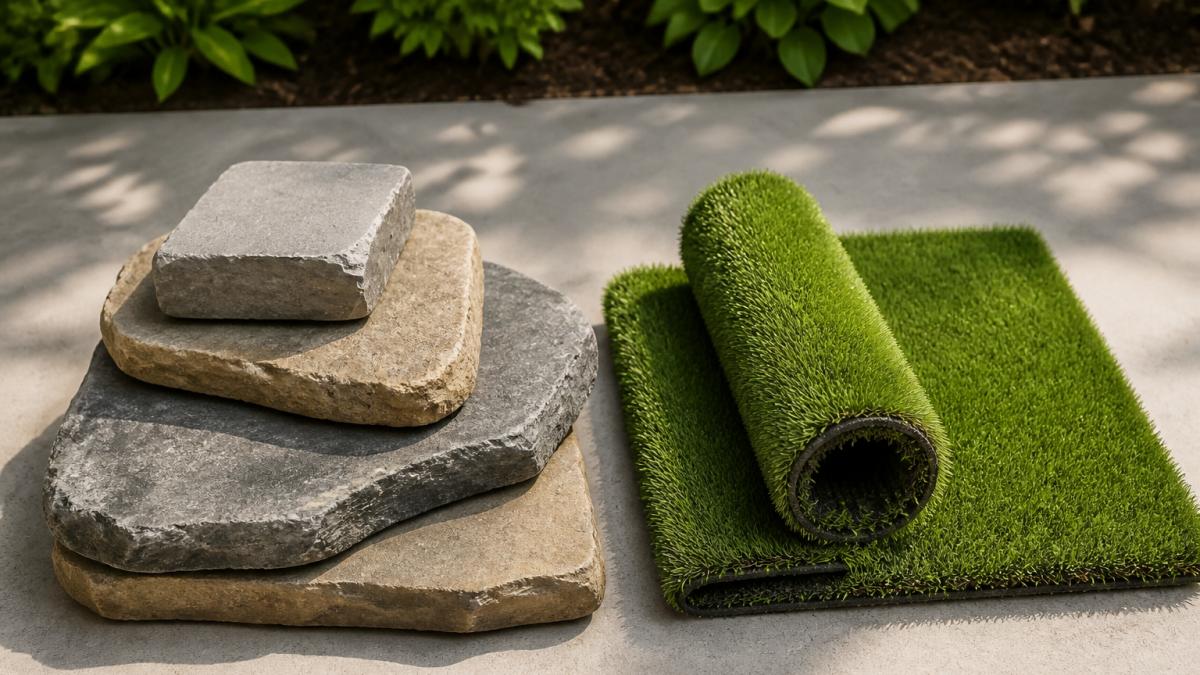
Natural stone is a hardscape material, meaning any surface built from cut or irregular stone, including pavers, flagstone, and bluestone, that carries foot traffic and supports structures. Artificial turf is a synthetic carpet of plastic grass blades infilled with sand or rubber, installed over a compacted base. One handles weight. The other handles play.
Below, we walk through the comparison that matters, where each surface wins, and the mistakes we see most often on backyard projects.
Natural Stone and Artificial Turf: Side-by-Side Comparison
| Factor | Natural Stone | Artificial Turf |
|---|---|---|
| Best for | Patios, walkways, fire pits | Play areas, pet runs, low-maintenance lawns |
| Surface feel | Hard, cool, permanent | Soft, consistent, warm in sun |
| Installation | Excavation, base, compaction, setting | Excavation, base, compaction, seaming, infill |
| Maintenance | Sweeping, occasional sealing, joint refill | Rinsing, brushing, infill top-ups |
| Lifespan | Decades with proper base | Shorter than stone; replaceable sections |
| Drainage | Depends on base and slope | Depends on base and perforation |
| Winter behavior | Plow-safe, freeze-thaw stable if built right | Can ice over; avoid metal shovels |
| Repair | Replace individual stones | Patch or re-stretch sections |
The table hides the real story. Both surfaces live or die on what's underneath them. A stone patio on a bad base shifts and heaves. Turf on a bad base puddles and ripples. That's why we treat base preparation as the project, not a step in it.
Natural Stone Patio Pros and Cons
A natural stone patio pros and cons list usually starts with appearance. That's the least useful place to start.
Where Natural Stone Wins
Stone lasts. A properly installed paver or flagstone patio holds up for decades, and individual pieces can be replaced without tearing out the whole surface. It handles heat better than turf, stays put under heavy furniture, and adds genuine resale value to a property. It also drains predictably when the base and slope are built correctly, which matters in a region that sees real freeze-thaw cycles.
For homeowners who want a fire pit, an outdoor kitchen, or a pool surround, stone isn't a preference. It's a requirement.
Where Natural Stone Falls Short
Stone is not soft, not cheap, and not maintenance-free. Joints collect debris and need occasional refilling. Some stone types need sealing to resist staining. In full sun, certain dark stones get hot enough to be uncomfortable barefoot. And installation is labor-intensive: excavation, graded base, compaction, and precise setting all take time and skill.
Artificial Turf Installation Cost: What Drives the Number
Artificial turf installation cost is driven by square footage, base depth, and site access, not by the turf itself. The material is often the smaller line item. Excavation, hauling, compacted aggregate base, seaming, and infill usually make up the bulk of the project.
Four factors move the number most:
- Square footage. Cost scales linearly with area.
- Site access. A backyard reachable only through a narrow gate means hand-carrying base material, which adds labor.
- Existing conditions. Removing old lawn, concrete, or tree roots adds excavation time.
- Drainage work. If the yard doesn't slope away from the house, grading and drainage corrections come first.
Because pricing depends on quantity, site conditions, and current material rates, we quote every project individually rather than publishing a flat number. Homeowners near Chesterfield can request a walkthrough and get a written scope before committing to anything.
One thing worth knowing: the cheapest quote is rarely the cheapest project. A low bid usually means a thinner base, less compaction, and no drainage correction. That's how turf ends up rippling two summers later.
Artificial Turf Drainage and Maintenance
Artificial turf drainage and maintenance are the two things that decide whether the surface still looks good in year five.
Drainage starts with the base. A properly built system uses a compacted aggregate layer that lets water pass through and a slope that moves it away from the house and toward a discharge point. Perforated backing on the turf helps, but it can't compensate for a flat, poorly compacted base. If your yard already holds water after rain, that problem has to be solved before turf goes down.
Maintenance is lighter than a lawn but not zero:
- Rinse the surface periodically to clear dust and pollen
- Brush the fibers to keep them upright in high-traffic spots
- Top up infill where it settles
- Remove leaves and debris so they don't mat the surface
- Skip metal shovels in winter; they cut the backing
Turf also runs warmer than natural grass in direct sun, and pet waste needs regular rinsing. Neither is a dealbreaker, but both are real.
Backyard Pavers vs Artificial Turf: Matching Surface to Use
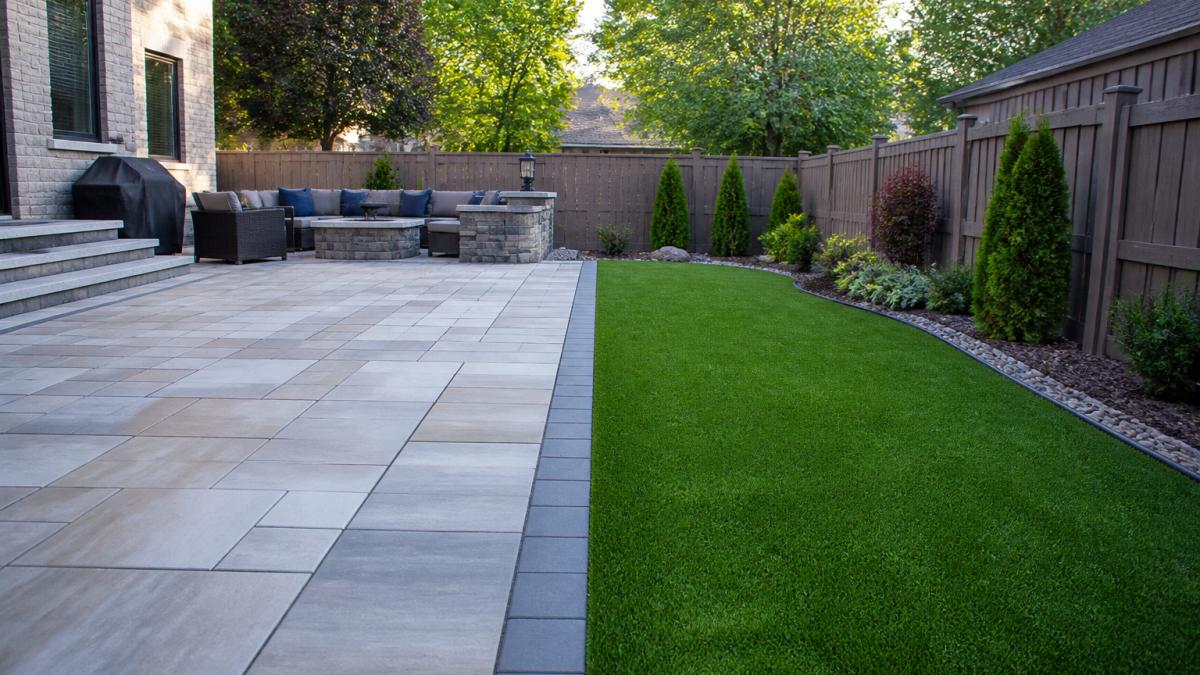
Backyard pavers vs artificial turf is really a question about zones. The best yards we build use both, divided by how each area gets used.
A simple way to decide:
- High-traffic, furniture, grills, fire features: pavers or stone
- Play areas, pet runs, barefoot zones: turf
- Transition strips and edging: stone borders hold turf in place and define zones
- Drainage paths: stone or gravel channels move water where turf shouldn't sit wet
Michigan Winters, Permits, and Base Prep: What Both Options Demand
Michigan winters are the equalizer. Freeze-thaw cycles punish shortcuts on both surfaces.
For stone, that means a base deep enough and compacted enough to resist heaving, plus proper joint material that flexes with movement. For turf, it means a base that drains fast so water doesn't freeze into sheets of ice, and a surface that won't be damaged by normal snow removal.
Permits matter too, and they vary by municipality. Grading that changes drainage, retaining walls over a certain height, and any work near utility lines often require review. We handle permit coordination and compliance as part of full-scope project management, so homeowners aren't chasing paperwork between contractors.
If you're searching for backyard surface installation near me in the Chesterfield area, the deciding factor usually isn't the material. It's whether one accountable team owns the excavation, base, drainage, and finish from start to finish.
Conclusion: Choosing the Right Backyard Surface
The right answer depends on how you live in your yard, not on which surface photographs better. Stone handles structure and traffic. Turf handles play and low upkeep. Most great backyards use both, installed over a base built to survive Michigan winters.
That's where Delpres Services LLC comes in. We bring 20+ years of hands-on expertise, one accountable team from start to finish, full-scope project management including permits and compliance, and complete backyard transformations built on proper excavation and drainage. Whether you're planning a stone patio, a turf lawn, or a mixed-surface yard in Metro Detroit, we'd rather build it once and build it right.
Book a consultation with Delpres Services LLC and get a clear scope, honest pricing, and a backyard that holds up.
Frequently Asked Questions
Is natural stone or artificial turf better for a backyard?
Neither wins outright. Natural stone suits patios, walkways, and high-traffic gathering areas, and it lasts decades with minimal upkeep. Artificial turf fits lawns, play zones, and pet runs where you want green cover without mowing. Many backyards use both: pavers for the patio, turf for the lawn. The deciding factors are how you use the space, your drainage plan, and your budget for installation and long-term care.
Which costs more to install: natural stone or artificial turf?
Natural stone pricing varies widely by type, thickness, and whether it is set in mortar or on a sand base. Both figures depend on site access, base depth, and drainage work, so request a written quote rather than relying on national averages.
How do natural stone and artificial turf hold up to Michigan winters?
Natural stone handles freeze-thaw cycles well when it sits on a properly compacted base with good drainage, though heaving can occur if water pools under the pavers. Artificial turf also survives winter, but snow, ice, and refreezing can flatten fibers and mat the infill. Neither surface should be cleared with a metal-edged shovel. Base preparation is the single biggest factor in how either option performs through a Southeast Michigan winter.
Which backyard surface drains better: natural stone or artificial turf?
Natural stone on an open-graded base drains quickly because water moves through the joints and into the subbase. Artificial turf drains through a perforated backing and base layer, but the rate depends on the infill type and whether the base was graded correctly. In both cases, the drainage plan matters more than the surface itself. Poor grading or compacted subsoil will cause pooling no matter which material you choose.