 listicle
Industrial Concrete Contractors: 2026 Selection Guide
Table of Contents
- What Sets Industrial Concrete Contractors Apart
- How We Evaluated These Contractors
- Top Industrial Concrete Contractors for 2026
- Delpres Services LLC: Full-Service Site Development
- Baker Construction Enterprises Inc.: Large-Scale Structural Concrete
- Lithko Contracting LLC: Regional Commercial and Industrial Projects
- Structural Group Inc.: Repair and Restoration Specialists
- Largo Concrete Inc.: Design-Build Structural Frames
- Suntec Concrete Inc.: High-Volume Industrial Concrete
- FX Concrete LLC: Turnkey Industrial Slabs
- Texas Structural Concrete (TSC): Industrial Restoration
- CAP Concrete: Dallas-Fort Worth Commercial and Industrial
- Concrete Contractors Association of Greater Chicago (CCAGC): Vetted Directory
- Industrial Concrete Floor Installation: What to Look For
- Concrete Foundation Repair: When and How to Address It
- OSHA Concrete Construction Safety Standards to Verify
- How to Choose the Right Contractor for Your Project
- Frequently Asked Questions
Last Updated: September 16, 2026
What Sets Industrial Concrete Contractors Apart
Industrial concrete contractors are specialized construction firms that build, pour, and finish the structural concrete, slabs, and foundations used in warehouses, manufacturing plants, and heavy commercial facilities. The distinction matters because industrial concrete work carries loads and tolerances that residential flatwork never approaches. A warehouse floor that sees forklift traffic all day needs different mix design, joint spacing, and finishing than a driveway.
Delpres Services LLC has spent more than 20 years handling excavation, foundations, footings, and flatwork across Metro Detroit, and the pattern we see is consistent: industrial clients care less about the lowest bid and more about whether the slab will still be flat in five years. That is a different buying decision than a homeowner replacing a sidewalk.
How We Evaluated These Contractors
Each contractor below was assessed on project scale, service scope, regional coverage, and specialization. We weighted self-performed work over brokered work, since a firm that owns its crews and equipment controls its own schedule. Pricing was excluded because industrial concrete is quoted per project, and any published figure would be meaningless without site conditions, square footage, and reinforcement requirements.
Top Industrial Concrete Contractors for 2026
The list below covers national firms, regional specialists, and one vetted directory. None of them are interchangeable. A restoration specialist is the wrong call for a new slab, and a high-volume national firm may not want a 4,000-square-foot job.
Delpres Services LLC: Full-Service Site Development
Delpres Services is our top pick for industrial concrete work in Metro Detroit because it handles the entire site, not just the pour. Excavation, underground utilities, storm and sanitary sewer, water main, footings, foundations, concrete flatwork, asphalt paving, and grading all sit under one accountable team. That matters on industrial sites, where a foundation delay caused by an uncooperative utility subcontractor can push an entire schedule.
The firm brings 20+ years of hands-on experience and full-scope project management that includes permits and compliance. For industrial facility managers who have dealt with contractors disappearing mid-project, the single-team model removes the handoff where blame usually lands.
Best for: Industrial and commercial projects in Metro Detroit that need site development and concrete from one contractor.
Baker Construction Enterprises Inc.: Large-Scale Structural Concrete
Best for: Large-scale industrial and commercial infrastructure where capacity matters more than local presence.
Lithko Contracting LLC: Regional Commercial and Industrial Projects
Best for: Complex commercial and industrial developments in regions where Lithko has an active office.
Structural Group Inc.: Repair and Restoration Specialists
Best for: Industrial facility maintenance and structural restoration of existing concrete assets.
Largo Concrete Inc.: Design-Build Structural Frames
Best for: Structural concrete frames for industrial and commercial buildings within Largo's service regions.
Suntec Concrete Inc.: High-Volume Industrial Concrete
Best for: High-volume industrial and commercial concrete projects with flexible scheduling windows.
FX Concrete LLC: Turnkey Industrial Slabs
Best for: Industrial and multi-family developments in Texas that want a single concrete contract.
Texas Structural Concrete (TSC): Industrial Restoration
Best for: Industrial concrete restoration in Texas where local code familiarity matters.
CAP Concrete: Dallas-Fort Worth Commercial and Industrial
Best for: Commercial and industrial concrete in the Dallas-Fort Worth area.
Concrete Contractors Association of Greater Chicago (CCAGC): Vetted Directory
| Contractor | Specialty | Service Area | Best Fit |
|---|---|---|---|
| Delpres Services LLC | Full-scope site development | Metro Detroit | Industrial projects needing one accountable team |
| Baker Construction | Large-scale structural concrete | National | Enterprise-scale infrastructure |
| Lithko Contracting | Turnkey commercial and industrial | Multi-region | Complex developments near an active office |
| Structural Group | Repair and restoration | National | Existing facility maintenance |
| Largo Concrete | Design-build structural frames | Regional | Structural frame projects |
| Suntec Concrete | High-volume site concrete | Regional | Large projects with flexible timing |
| FX Concrete | Turnkey industrial slabs | Texas | Single-contract concrete scope |
| Texas Structural Concrete | Industrial restoration | Texas | Code-sensitive restoration work |
| CAP Concrete | Commercial and industrial flatwork | Dallas-Fort Worth | Local DFW projects |
| CCAGC | Vetted contractor directory | Chicago | Sourcing a pre-screened list |
Industrial Concrete Floor Installation: What to Look For
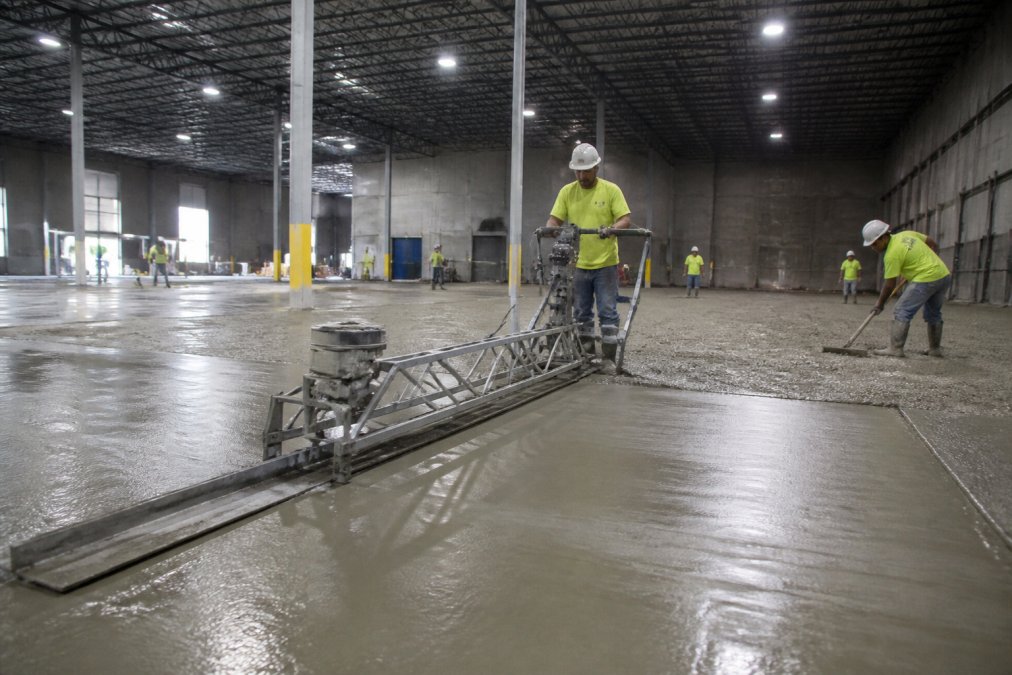
Industrial concrete floor installation succeeds or fails on three decisions made before any concrete arrives: subgrade preparation, mix design, and joint layout. A floor that fails usually failed at one of those stages, not during the pour.
Subgrade prep is where most problems start. Compaction testing should happen before forms go up, not after. If a contractor skips a proof-roll or density test, the slab is resting on unknown ground.
Mix design should match the load. A slab specified for light warehouse traffic will crack under loaded forklifts. Ask what compressive strength the mix targets and why.
Joint layout determines long-term maintenance cost. Poorly spaced joints crack where you do not want them, and repairing joints in an active facility means downtime.
Concrete Foundation Repair: When and How to Address It
Concrete foundation repair is warranted when you see structural symptoms, not cosmetic ones. Hairline cracks in a slab are normal. Cracks wider than a quarter inch, doors that stop closing, or visible settlement at column bases are not.
The distinction between cosmetic and structural damage determines both urgency and method. Cosmetic cracks get sealed. Structural movement needs an engineer's assessment before any repair method is chosen. Skipping that step and patching the symptom is how facilities end up repairing the same foundation twice.
For industrial facilities, the timing question is usually operational: can the repair happen during a shutdown window, or does it need to be phased around production? Contractors who work in active industrial environments plan around that constraint. Contractors who do not will disrupt your operations.
OSHA Concrete Construction Safety Standards to Verify
Safety compliance is verifiable, and you should verify it before awarding a contract. The OSHA concrete and masonry construction standards set requirements covering PPE, fall protection, silica exposure control, and equipment operation on concrete job sites. Under OSHA's respirable crystalline silica rule for construction, contractors must control dust during cutting, grinding, and demolition of concrete.
Ask for the contractor's written silica control plan. Ask how they document toolbox talks and equipment inspections. A firm that cannot produce those documents on request is a firm that is not managing safety systematically.
How to Choose the Right Contractor for Your Project
Match the contractor's specialization to your project type before you compare anything else. A restoration specialist bidding on new construction, or a high-volume national firm bidding on a small slab, is a mismatch regardless of price.
Use this checklist when evaluating candidates:
- Confirm the contractor self-performs concrete placement rather than subcontracting it
- Request the silica exposure control plan and recent OSHA 300 logs
- Verify licensing and insurance for your state and municipality
- Ask for three references on projects of similar scope and scale
- Confirm who holds the permit and who manages inspections
- Get the joint layout and mix design in writing before signing
- Clarify how change orders are priced and approved
- Ask what happens if the schedule slips
For industrial facility managers in Chesterfield and across Metro Detroit, the practical question is whether one contractor can carry the project from excavation through final finish.
Frequently Asked Questions
What services do industrial concrete contractors in Chesterfield provide?
Industrial concrete contractors in Chesterfield offer a range of services including site preparation, excavation, structural concrete construction, industrial concrete floor installation, concrete foundation repair, and underground utility installation. They also handle asphalt paving, grading, drainage solutions, and demolition. Many full-service firms like Delpres Services LLC provide end-to-end project management, including permits and compliance with local regulations. These contractors serve industrial facilities, commercial developments, and municipal infrastructure projects throughout the Metro Detroit area.
How do I verify the credentials of an industrial concrete contractor?
Start by checking for a valid state contractor license and insurance coverage. Ask for proof of workers' compensation and general liability insurance. Verify their safety record by requesting their OSHA compliance history, particularly for concrete construction safety standards. Look for industry affiliations and certifications. Request references from similar industrial projects and follow up with those clients. Also confirm they have experience with the specific type of work you need, such as industrial concrete floor installation or concrete foundation repair. Delpres Services LLC, for example, has over 20 years of experience and provides full-scope project management including permits and compliance.
What is the difference between commercial and industrial concrete work?
Commercial concrete work typically involves retail spaces, offices, and multi-family buildings, focusing on standard foundations, sidewalks, and parking lots. Industrial concrete work is engineered for heavier loads, chemical exposure, and specialized equipment. It includes thick slabs for manufacturing floors, machine foundations, containment structures, and heavy-duty pavement. Industrial projects often require stricter tolerances, enhanced reinforcement, and compliance with OSHA concrete construction safety standards.
What safety standards should industrial concrete contractors follow in Missouri?
Industrial concrete contractors in Missouri must follow OSHA concrete construction safety standards, including 29 CFR 1926 Subpart Q. This covers requirements for equipment, PPE, fall protection, and safe handling of concrete. Verify that your contractor has a written safety program, provides ongoing training, and maintains a low incident rate. Delpres Services LLC emphasizes safety and compliance in all projects, ensuring adherence to federal and local regulations.