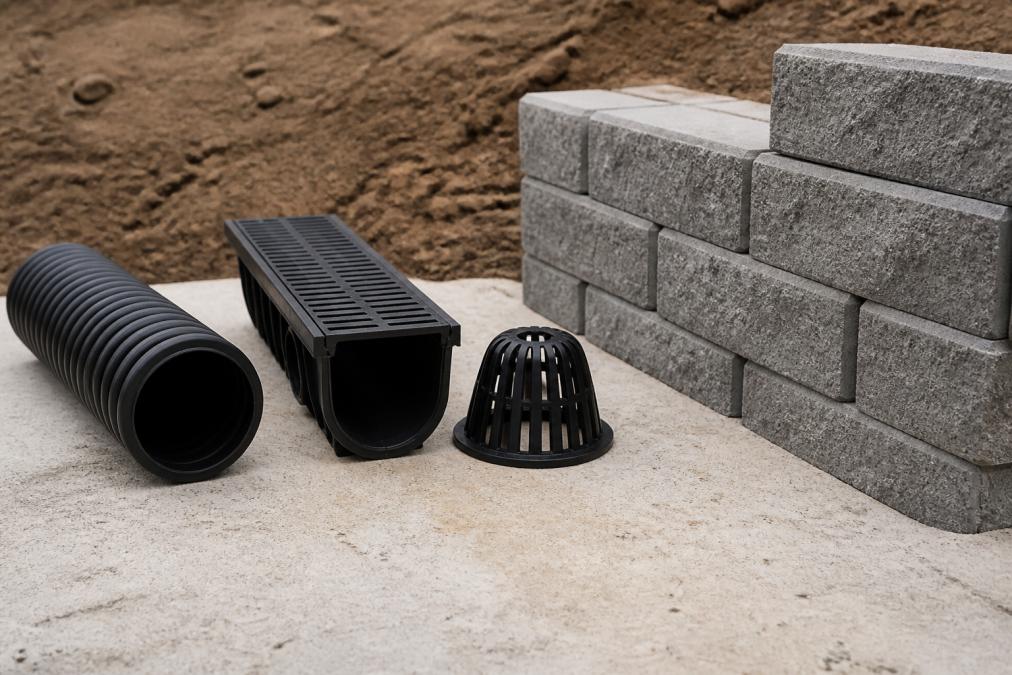
 comparison
Site Drainage Solutions vs Retaining Walls: Which Do You Need?
Table of Contents
- Site Drainage Solutions vs Retaining Walls: What’s the Difference?
- Quick Comparison: Drainage vs. Structural Support
- When a French Drain Installation Cost Is Your Main Concern
- Retaining Wall Drainage Requirements: Why Walls Fail Without It
- Signs You Need Yard Grading Services in Metro Detroit
- Can You Combine Site Drainage Solutions and Retaining Walls?
- How to Decide: Questions to Ask Before You Excavate
- Frequently Asked Questions
Last Updated: September 9, 2026
Site Drainage Solutions vs Retaining Walls: What’s the Difference?
A soggy, eroding yard in Metro Detroit often leaves homeowners asking whether they need site drainage solutions or a retaining wall, and the answer depends on what is actually failing beneath the surface. Site drainage solutions manage water movement, while retaining walls provide structural support for soil. At Delpres Services LLC, we handle both.
A retaining wall is a structure engineered to hold back soil and create level ground on sloped terrain. A drainage solution, by contrast, redirects surface or groundwater away from foundations, low spots, and saturated soil. The distinction matters because water pressure, not the soil itself, causes most wall failures and foundation issues.
Below, we’ll walk through how to tell which problem you have, what each fix costs, and when you need both working together.
Quick Comparison: Drainage vs. Structural Support
The fastest way to decide is to look at what your yard is doing. If soil is sliding, bulging, or collapsing down a slope, you need structural support. If water is pooling, seeping into a basement, or turning grass to mud, you need drainage.
| Problem You See | What’s Happening | Likely Solution |
|---|---|---|
| Soil sliding or bulging on a slope | Gravity and erosion destabilize the earth | Retaining wall for structural support |
| Standing water after rain | Poor grading or compacted soil traps water | French drain or catch basin |
| Cracks in a wall or leaning structure | Hydrostatic pressure from trapped water | Drainage behind the wall, plus repairs |
| Water seeping into the basement | Subsurface water migrating toward the foundation | Exterior drainage and grading |
| Flat yard with no slope away from house | Water has nowhere to go | Yard grading to direct runoff |
A common mistake is installing drainage where a wall is needed, or vice versa. Drainage does not hold back soil, and a wall without proper drainage will eventually fail under pressure. If you’re unsure which condition you have, a site evaluation by an experienced contractor is the safest first step.
When a French Drain Installation Cost Is Your Main Concern
If your primary problem is standing water and wet soil, a French drain system is often the most direct site drainage solution, and it is generally less invasive than building a structural wall. A French drain consists of a perforated pipe surrounded by gravel or crushed stone, installed in a trench to capture and redirect subsurface water.
French drain installation cost varies widely because it depends on trench length, depth, soil conditions, and how the water is routed away from your property. A reputable contractor will assess the linear footage needed, the excavation required, and the discharge point before pricing the job.
For homeowners comparing costs, the real question is what the project must accomplish. A French drain prevents basement flooding and soil saturation. A retaining wall stabilizes terrain. When water is the cause of erosion on a slope, you may need both, and that is where a full-service contractor prevents double spending.
Retaining Wall Drainage Requirements: Why Walls Fail Without It
Retaining wall drainage requirements are not optional, and ignoring them is the single most common reason walls collapse. Water builds up behind a wall, creating hydrostatic pressure that pushes against the structure until it cracks, bows, or tips over.
Every engineered wall needs a drainage system behind it, typically crushed stone and perforated pipe, to relieve that pressure. The pipe collects water and carries it away before it can saturate the backfill. SDR-35 PVC drainage pipe is a strong choice for this application because its rigid construction and smooth interior resist crushing and prevent debris buildup over time.
This is where the two systems converge. The wall holds the soil, and the drainage keeps the wall alive. Contractors who skip the drainage layer to save money are building a failure into the project.
Signs You Need Yard Grading Services in Metro Detroit
Some water problems trace back to simple grading. If your yard slopes toward the house, or has low spots where water collects, regrading may solve the issue without any pipes or walls at all. Yard grading services in Metro Detroit reshape the surface so runoff moves away from structures and toward an appropriate discharge point.
The clay-heavy soils common across Metro Detroit can drain poorly, which makes proper grading especially important here. A yard that looks flat can still funnel water into a foundation. A professional grade creates a consistent slope, typically away from the home, and can be combined with swales or catch basins to manage heavy runoff.
For properties with significant elevation changes, grading and a retaining wall often work together. The grade directs surface water, while the wall stabilizes the slope the grading creates.
Can You Combine Site Drainage Solutions and Retaining Walls?
In many backyards, the answer is yes, and it is the correct engineering approach. A sloped yard that needs terracing also needs drainage behind each wall to prevent water from undermining the structure. Combining site drainage solutions and retaining walls creates a system where water is managed and soil is stabilized.
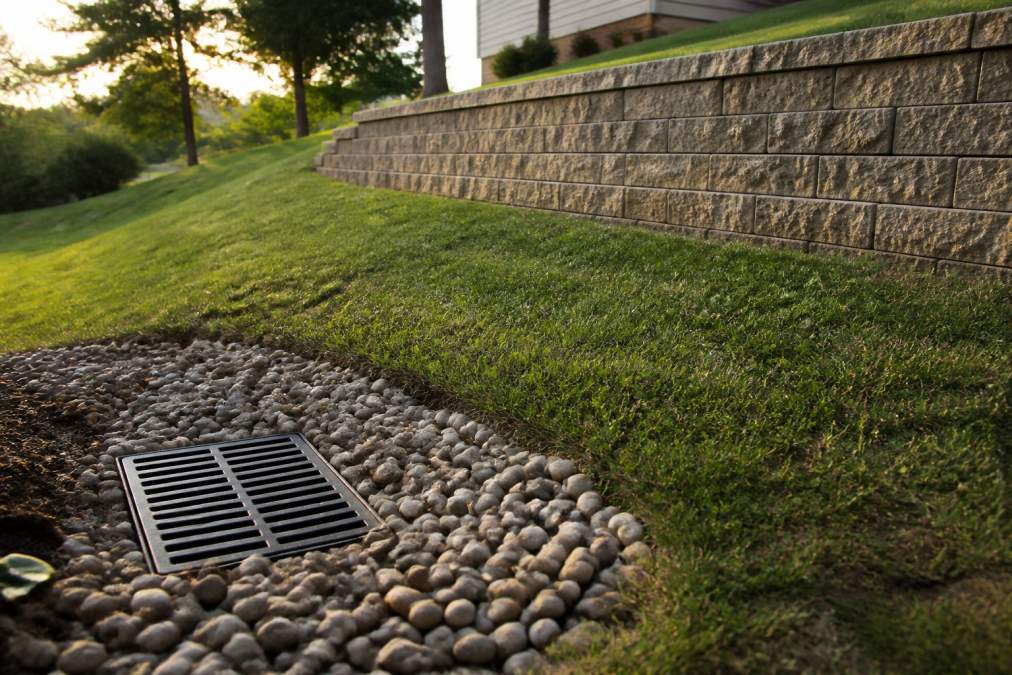
The typical combined project includes a modular concrete block wall to hold back the slope, crushed stone and perforated pipe behind the wall to relieve hydrostatic pressure, and either a French drain or catch basin at the low point to move water off the property. For a homeowner in Chesterfield, this might look like a terraced backyard with a patio above and a dry, level lawn below.
A full-service contractor handles the coordination between these systems. One team manages excavation, wall construction, drainage installation, and final grading, so the components are engineered to work together rather than patched together by separate crews.
How to Decide: Questions to Ask Before You Excavate
Before any digging starts, answer these questions with the help of an experienced contractor. The answers determine whether you need drainage, a wall, or both.
- Is the ground moving, or is water pooling? Movement means structural support. Pooling means drainage.
- Which way does the yard slope? If it slopes toward the house, grading is non-negotiable.
- Is there an existing wall? If so, does it have drainage behind it? Most older walls do not.
- Where will the water go? Every drainage system needs an outlet, whether a storm sewer, ditch, or low area.
- What is the soil like? Metro Detroit’s clay soils require more aggressive drainage than sandy ground.
The engineering guidance from the U.S. Department of Housing and Urban Development on drainage and grading emphasizes that proper site grading and drainage are fundamental to protecting a home’s foundation. For taller walls, the National Association of Home Builders guidance on retaining wall construction recommends professional engineering review, and the American Society of Civil Engineers’ resources on retaining structures detail how drainage is critical to structural longevity.
For most Metro Detroit homeowners, the deciding factor is simple: water pooling on flat ground points to drainage, while soil sliding on a slope points to a wall. When both conditions exist, and they often do, a combined approach is the only durable fix.
Choosing between site drainage solutions and retaining walls does not have to be a guess, but it does require an honest assessment of what is happening on your property. Water against a foundation needs drainage. Soil on a slope needs structure. And when a wall is involved, drainage is not optional, it is what keeps the wall standing.
At Delpres Services LLC, our team brings over 20 years of hands-on expertise to excavation, grading, drainage, and retaining wall construction across Metro Detroit. One accountable team manages the full scope, from permits and compliance to final grading. Book a consultation with Delpres Services LLC and get a clear answer on what your yard actually needs.
Frequently Asked Questions
Do I need a retaining wall for drainage or just a French drain?
If your only problem is standing water or soggy soil on relatively flat ground, a French drain system is the direct fix. If you have a slope that is eroding or soil that is pushing against a structure, you need a retaining wall for structural support. A French drain moves water out of the soil; a retaining wall holds soil back. Many Metro Detroit properties with sloped lots end up needing both, since a wall without proper drainage will fail under hydrostatic pressure.
Does a retaining wall require a drainage system behind it?
Yes, retaining wall drainage requirements are non-negotiable for engineered walls. Without a drainage system, water builds up in the soil behind the wall, creating hydrostatic pressure that can crack, bow, or collapse the structure. A proper installation includes a gravel backfill, a perforated drainage pipe at the base, and often a filter fabric to prevent soil from clogging the system. This is standard practice for any professional retaining wall installation in Metro Detroit.
Can a retaining wall solve standing water problems in my yard?
Only if the standing water is caused by a slope or erosion issue. A retaining wall creates level terraces and stops soil from migrating, which can indirectly improve drainage. However, if water pools because of poor soil composition or a low spot in an otherwise flat yard, a retaining wall will not help. In that case, a French drain or catch basin is the correct site drainage solution. A professional site evaluation will identify the actual cause of the pooling.
How much does it cost to install a French drain vs. a retaining wall in Metro Detroit?
French drain installation cost is generally project-based and depends on the linear footage, depth, and whether the pipe connects to a municipal storm system or a dry well. Retaining walls often require engineered materials and structural design. For a precise estimate, a contractor must assess soil conditions and access. Contact Delpres Services for a site-specific quote on either solution.