 ultimate-guide
Avoiding Construction Budget Overruns: A 2026 Guide
Table of Contents
- Common Causes of Construction Cost Overruns
- Construction Contingency Budget Calculation: How to Build Your Financial Buffer
- Accurate Project Estimation and Pre-Construction Planning
- Managing Construction Change Orders Before They Blow Your Budget
- How Construction Project Management Software Prevents Construction Budget Overruns
- Tracking Actual Costs vs. Budget in Real Time
- Post-Mortem Analysis: Learning from Every Project to Prevent Future Construction Budget Overruns
- Conclusion
Last Updated: August 9, 2026
Common Causes of Construction Cost Overruns
Construction budget overruns follow predictable patterns. At Delpres Services LLC, we've managed complex site development and construction projects across Metro Detroit for over 20 years, and the same root causes appear regardless of project size or type. The most dangerous misconception is that overruns happen because of bad luck. They don't. They happen because of bad systems.
Scope Creep and Inaccurate Project Estimation
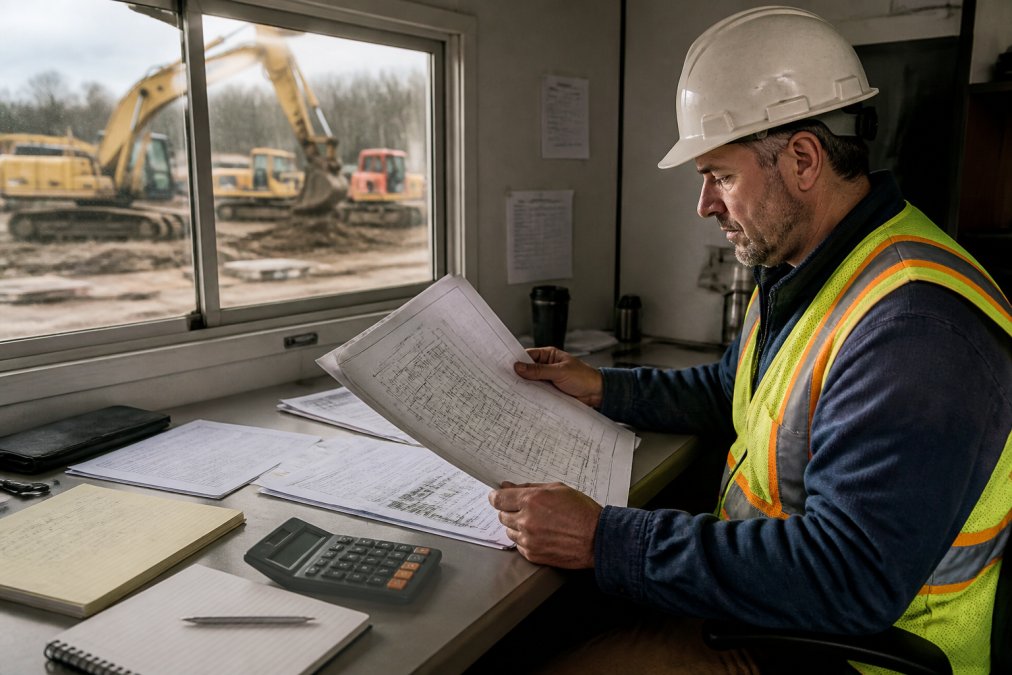
Scope creep, the gradual expansion of project requirements beyond what was originally agreed upon, is one of the most consistent drivers of cost overruns. Inaccurate project estimation compounds the problem. When initial bids are built on incomplete site surveys, vague specifications, or optimistic assumptions about labor productivity, the gap between estimated and actual costs widens fast. Many project teams underestimate underground utility complexity, soil conditions, or permitting timelines, all of which drive unforeseen expenses that contingency funds weren't sized to absorb. The fix is a better estimate from the start, not a bigger buffer.
Material Price Volatility and Labor Productivity Issues
Material price volatility is a structural challenge in modern construction. Prices for concrete, asphalt, steel, and aggregate can shift significantly between bid date and procurement, particularly on extended projects. Fixed-price contracts without escalation clauses leave contractors absorbing genuinely unforeseeable costs.
Labor productivity issues are equally damaging. Crew scheduling conflicts, subcontractor delays, and equipment downtime compress the project schedule and drive up cost per unit of work. Resource allocation decisions made during pre-construction planning directly determine labor efficiency once work begins.
The Psychology Behind Budget Overruns
Optimism bias leads estimators and owners to systematically underestimate costs and timelines. Planning fallacy causes teams to focus on best-case scenarios rather than realistic risk mitigation. According to research on megaproject cost overruns published by Oxford University's Saïd Business School, the majority of large infrastructure projects exceed their original budgets, with optimistic forecasting as the primary driver, not external shocks.
Construction Contingency Budget Calculation: How to Build Your Financial Buffer
A contingency fund is a dedicated financial reserve built into the project budget to cover unforeseen expenses. It is not a slush fund or excuse for poor planning, it is a calculated buffer sized to the actual risk profile of the project.
Construction contingency budget calculation varies by project type and complexity:
| Project Type | Typical Contingency Range | Key Risk Factors |
|---|---|---|
| Residential site work | 5-10% of base contract | Soil conditions, utility conflicts |
| Commercial site development | 10-15% of base contract | Permitting delays, subcontractor risk |
| Municipal infrastructure | 15-20% of base contract | Regulatory changes, underground unknowns |
| Industrial heavy construction | 10-20% of base contract | Material price volatility, schedule risk |
Projects with extensive underground utility work, poor existing documentation, or aggressive schedules warrant contingency at the higher end. Projects with thorough geotechnical surveys, clear specifications, and experienced subcontractors can reasonably target the lower end. The critical mistake most owners make is treating contingency as optional. A project without a financial buffer requires emergency budget decisions under pressure, and those decisions are always more expensive than proper planning.
Accurate Project Estimation and Pre-Construction Planning
Accurate estimation is the single highest-use activity in construction cost control. Every dollar of overrun during construction can typically be traced back to a gap in pre-construction planning.
Thorough pre-construction planning includes geotechnical investigation, utility locates, permit research, and detailed quantity takeoffs before any bid is finalized. Projects that skip these steps to accelerate the schedule consistently pay for it during construction at a much higher rate than the upfront investment would have cost. According to the Construction Industry Institute's research on front-end planning, projects that invest adequately in pre-project planning consistently outperform those that don't on both cost and schedule metrics.
Bid Accuracy and Vendor Vetting
Bid accuracy depends on the quality of scope documents presented to vendors and subcontractors. Vague or incomplete scopes produce bids that are either inflated with risk premiums or stripped of legitimate line items that will surface as change orders later.
Vendor vetting is equally important. Subcontractors with a history of bid shopping, poor documentation, or thin financial capacity introduce risk that no contract language fully eliminates. Effective subcontractor management includes verifying licensure, insurance, and bonding; reviewing references from comparable projects; confirming equipment capacity and crew availability; and evaluating financial stability to ensure the subcontractor can sustain operations through payment cycles.
Managing Construction Change Orders Before They Blow Your Budget
A change order is a formal modification to the original contract scope, price, or schedule. Managed properly, it is a legitimate tool. Managed poorly, it becomes the primary mechanism through which construction budget overruns occur.
The most common change order problem is the absence of a formal process for evaluating, pricing, and approving them before work proceeds. When field crews make scope modifications without written authorization, the project loses both cost control and contractual protection.
A disciplined change order process includes: written request from the initiating party, scope description with specific quantities and specifications, cost impact analysis before approval, schedule impact assessment, formal written approval from the authorized owner representative, and updated budget and schedule baseline after approval.
Legal and Contractual Safeguards for Change Orders
Contract structure is a genuine cost control tool. The choice between a fixed-price contract and a cost-plus contract fundamentally shapes how budget risk is allocated between owner and contractor.
Fixed-price contracts transfer risk to the contractor for clearly defined scope items, creating strong incentives for accurate estimation and efficient execution. Cost-plus contracts shift risk back to the owner and work well when scope is genuinely undefined, but they require rigorous cost tracking and audit rights to prevent budget drift.
As documented in AIA Contract Documents guidelines for construction agreements, well-drafted construction contracts should include explicit change order thresholds, dispute resolution procedures, and documentation requirements. Owners should also include provisions for notice requirements before proceeding with changed work, time limits for submitting change order pricing, dispute escalation procedures that don't immediately default to litigation, and audit rights for cost-plus or time-and-material components.
How Construction Project Management Software Prevents Construction Budget Overruns
Construction project management software has fundamentally changed what's possible in real-time cost control. The gap between teams using integrated platforms and those relying on spreadsheets and email is measurable in project outcomes.
Modern platforms centralize budget tracking, change order management, RFI documentation, and subcontractor communication in a single environment, eliminating version control problems that cause budget variance to go undetected. Key capabilities include real-time cost tracking against the approved budget by cost code, change order workflow with approval routing and audit trail, procurement tracking from purchase order to invoice reconciliation, subcontractor management including insurance certificate tracking, document control with version history, and KPI dashboards visible to both field and office teams. Platform integration with the accounting system eliminates manual reconciliation work that introduces errors and delays.
Tracking Actual Costs vs. Budget in Real Time
Real-time cost tracking is the operational core of construction budget control. Without it, project teams make decisions based on historical data that may be weeks old, by which time budget variance has compounded.

Effective cost tracking requires that every expenditure, including labor hours, material deliveries, equipment charges, and subcontractor invoices, is coded to the correct budget line item at the time it is incurred. This is a daily operational discipline, not an accounting function performed at month-end.
KPI Tracking and Budget Variance Reporting
Budget variance is the difference between planned and actual cost for any given scope item or period. Tracking budget variance in real time allows project managers to identify cost overrun trends before they become unrecoverable.
| KPI | What It Measures | Warning Threshold |
|---|---|---|
| Cost Performance Index (CPI) | Earned value vs. actual cost | Below 0.95 |
| Schedule Performance Index (SPI) | Earned value vs. planned value | Below 0.90 |
| Change Order Rate | Change orders as % of base contract | Above 10% |
| Contingency Burn Rate | Contingency spent vs. % complete | Ahead of schedule |
| Subcontractor Invoice Accuracy | Invoiced vs. approved quantities | Any discrepancy |
A CPI below 1.0 means the project is spending more than it is earning in completed work. Catching that signal at week four is recoverable. Catching it at week fourteen often isn't. According to the Project Management Institute's guidance on earned value management, teams that implement earned value management consistently identify cost overrun trends earlier and resolve them at lower total cost than teams relying on periodic budget reviews alone.
Post-Mortem Analysis: Learning from Every Project to Prevent Future Construction Budget Overruns
Post-mortem analysis is the most underused tool in construction cost management. Most project teams move immediately from closeout to the next bid without systematically documenting what drove cost variances.
A structured post-mortem should cover estimation accuracy review, change order analysis documenting root causes, subcontractor performance review, contingency use analysis, and schedule impact analysis. The output is updated unit cost data, revised vendor ratings, and improved scope templates that make the next project estimate more defensible from day one.
Construction budget overruns are a controllable problem, not an inevitable one. Teams that consistently deliver projects on budget do so because they've built disciplined systems for estimation, change order management, real-time cost tracking, and post-project learning. At Delpres Services LLC, that discipline is built into every project we take on, from pre-construction planning through final closeout, backed by 20+ years of hands-on expertise and full-scope project management that includes permits, compliance, and end-to-end coordination. If you're planning a site development, excavation, concrete, or infrastructure project in Metro Detroit and want a team that treats cost control as a core deliverable, book a consultation with Delpres Services LLC today.
Frequently Asked Questions
What is the main cause of construction budget overruns?
The most frequent cause is inaccurate project estimation during the planning phase. When bids underestimate labor productivity, material costs, or project complexity, the budget starts underwater before a single shovel hits the ground. Scope creep compounds the problem: clients request additions, and without a formal change order process, those extras absorb the contingency fund and push costs well past the original contract value. Poor subcontractor management and unforeseen site conditions are also common contributors.
How do you calculate a contingency budget for construction?
A construction contingency budget is typically calculated as a percentage of the total project cost. For well-defined projects with a detailed scope, 5-10% is a common starting point. Projects with higher complexity, longer timelines, or significant unknowns, such as underground utility conflicts or soil conditions, warrant 15-20%. The contingency fund should be tracked separately from the main budget and released only through a documented approval process, not treated as general spending money throughout the project lifecycle.
What percentage should you add to a construction budget for overruns?
Most construction professionals recommend adding 10-15% to the base budget as a financial buffer for unforeseen expenses. Simpler residential projects may need only 5-10%, while complex commercial or municipal projects with long procurement chains and multiple subcontractors often require 15-20%. The right figure depends on bid accuracy, the fixed-price vs. cost-plus contract structure, site conditions, and how thoroughly the scope was defined before construction began.
How can technology help prevent construction cost overruns?
Construction project management software gives teams real-time tracking of actual costs against the approved budget, so variance is visible the moment it develops rather than weeks later. Digital tools also centralize project documentation, automate change order workflows, and flag schedule slippage before it becomes a capital expenditure problem. When integrated with procurement and subcontractor management systems, these platforms create full project visibility across every cost category, reducing the risk of budget surprises late in the project lifecycle.
What are the best practices for managing construction change orders?
Every change order should be documented in writing before any additional work begins, verbal approvals are not enforceable. The written record should include a clear description of the scope change, the cost impact, the schedule impact, and signatures from both parties. Establish a formal change order log at project kickoff and review it at every progress meeting. Tying change order approval to budget variance thresholds adds accountability and prevents small additions from quietly accumulating into a major cost overrun.
How does a fixed-price contract differ from a cost-plus contract in controlling costs?
A fixed-price contract locks the contractor into a set price for a defined scope, transferring most cost overrun risk to the contractor. This gives owners budget certainty but only works when the scope is fully defined upfront. A cost-plus contract pays the contractor for actual expenses plus a fee, giving more flexibility for complex or evolving projects but requiring rigorous real-time tracking and audit rights to prevent runaway spending. Choosing the right structure depends on how well-defined the project scope is before construction begins.
This article was written using GrandRanker